Saturday, February 28, 2009

Statues Thought Reponse

Someone called and asked what statuary collection I had. These are just a few of them. There are 11 other statues and religious art pictures! Saints be to God ... they are all over the place here!!!


Friday, February 27, 2009

Riding the Rails: An Interesting Thought for Lent

People ask me, What is the purpose of life? And I respond: In a nutshell, life is preparation for eternity. We were not made to last forever, and God wants us to be with Him in Heaven. One day my heart is going to stop, and that will be the end of my body-- but not the end of me. I may live 60 to 100 years on earth, but I am going to spend trillions of years in eternity. This is the warm-up act - the dress rehearsal. God wants us to practice on earth what we will do forever in eternity.

We were made by God and for God, and until you figure that out, life isn't going to make sense.
Life is a series of problems: Either you are in one now, you're just coming out of one, or you're getting ready to go into another one. The reason for this is that God is more interested in your character than your comfort; God is more interested in making your life holy than He is in making your life happy.

We can be reasonably happy here on earth, but that's not the goal of life. The goal is to grow in character, in Christ likeness. This past year has been the greatest year of my life but also the toughest, with my wife, Kay, getting cancer. I used to think that life was hills and valleys - you go through a dark time, then you go to the mountaintop, back and forth.. I don't believe that anymore.

Rather than life being hills and valleys, I believe that it's kind of like two rails on a railroad track, and at all times you have something good and something bad in your life. No matter how good things are in your life, there is always something bad that needs to be worked on. And no matter how bad things are in your life, there is always something good you can thank God for.

You can focus on your purposes, or you can focus on your problems: If you focus on your problems, you're going into self-centeredness, which is 'my problem, my issues, my pain.' But one of the easiest ways to get rid of pain is to get your focus off yourself and onto God and others.

We discovered quickly that in spite of the prayers of hundreds of thousands of people, God was not going to heal Kay or make it easy for her- It has been very difficult for her, and yet God has strengthened her character, given her a ministry of helping other people, given her a testimony, drawn her closer to Him and to people....

You have to learn to deal with both the good and the bad of life. Actually, sometimes learning to deal with the good is harder. For instance, this past year, all of a sudden, when the book sold 15 million copies, it made me instantly very wealthy. It also brought a lot of notoriety that I had never had to deal with before. I don't think God gives you money or notoriety for your own ego or for you to live a life of ease.

So I began to ask God what He wanted me to do with this money, notoriety and influence. He gave me two different passages that helped me decide what to do, II Corinthians 9 and Psalm 72.

First, in spite of all the money coming in, we would not change our lifestyle one bit. We made no major purchases.

Second, about midway through last year, I stopped taking a salary from the church.

Third, we set up foundations to fund an initiative we call The Peace Plan to plant churches, equip leaders, assist the poor, care for the sick, and educate the next generation.

Fourth, I added up all that the church had paid me in the 24 years since I started the church, and I gave it all back. It was liberating to be able to serve God for free.

We need to ask ourselves: Am I going to live for possessions? Popularity?
Am I going to be driven by pressures? Guilt? Bitterness? Materialism? Or am I going to be driven by God's purposes (for my life)?

When I get up in the morning, I sit on the side of my bed and say, God, if I don't get anything else done today, I want to know You more and love You better. God didn't put me on earth just to fulfill a to-do list. He's more interested in what I am than what I do. That's why we're called human beings, not human doings.

Happy moments, PRAISE GOD.
Difficult moments, SEEK GOD.
Quiet moments, WORSHIP GOD.
Painful moments, TRUST GOD.
Every moment, THANK GOD.

A recent interview with Rick Warren, The Purpose Driven Life.

Thought for the Day: Friday, Feb 27, 2009

STATUES

There were days when our faith practices were so very different than they are today.

Statues. Most Catholic homes had a statue of Mary or Joseph or Francis and often a crucifix -- all to remind us of the presence and assistance of the "holy ones."

These images kept us in touch with our God and the saints. The statues has disappeared from most places except churches -- and there are some Pastors who want them gone from that hallowed place as well. Nonetheless, our minds were, even for just a brief moment, lifted beyond the circumstances that most likely brought us to look at the statue and open a very quiet moment of dialog with the saint of Jesus or God or the Holy Spirit.

Is it not a surprise, then, that the challenges we face each day seem more difficult when we don't have someone helping us? We might think these replicas of people we have never met are "out of date." Strange: the pains, difficulties and challenges these wonderful people and God helped us through have not changed, have not disappeared.

Just a thought, not a sales pitch!

Friday After Ash Wednesday, Feb 27 2009

The excesses we reduce; the reaching out to those who have lost their jobs or their homes; helping those who are alone and most likely suffering loneliness; and reassuring those elderly in their worries over what little they might have; and encouraging those young people who have had to leave college because of funding: all of these and many other practices might indeed be the sacrifices we might consider during this particular Lenten season. Being a brother or sister to another person who is in dire straits might well be among the challenges that bring about a deeper awareness of who each of us truly is.

Again, Lent is a journey. Travel, the travel of any journey, can be a transformation. Going from where you are to a new place makes your somewhat different. Imagine the change if you have lost your job and have to make the trip to the unemployment line ... for a first time ... and it is not your fault! That is a change in who a person might be. The sense of failure muse be overwhelming especially if that person's family will suffer because of the circumstances.

On the brighter side, most people feel a sense of excitement on setting out and along a journey to a new place. This is what Lent can bring to us even in our down in the dumps feelings. Lent, a time of growing closer to the Lord, can bring us to a new place, to a new sense of our relationship to the Redeemer.

In our churches, at every celebration of the Eucharistic Liturgy, the celebrant initiates a series of petitions for our prayers. Are we bringing the very painful needs of our sisters and brothers to the altar each day?

Wednesday, February 25, 2009

Feburary 26, 2009: Thought for Today


The Lenten Journey
Journey -- from the French for one day's travel

The Lenten Journey
A season's travel inside who I am.

Like the journey to Selma
Not just a journey from one city to another
As a nation, we came to know something of a terrible sin
that still remained after Emancipation
A journey that made us open our eyes, our hearts and minds.

What is this year's Lenten Journey going to teach me?

Da Vinci wrote words similar to these
Having made a journey into the heavens,
even though you walk the soil
you will often look skyward
wanting to be there.

Once I have tasted the freedom of self-discovery
I want more.

Never turn away from the invitation.

Thurday after Ash Wednesday


Without the ashes today am I a Catholic?

Yesterday evening Cardinal McCarrick was the guest celebrant for our AshWednesday Mass at St. Joseph's on Capitol Hill. He spoke about how powerful the symbolism of ashes on our foreheads was throughout the city. On streets, on Metro cars, on busses, in our offices and our homes -- that smudge of burnt palm leaves was a clear sign to all who looked on them: there is a Catholic. Yes, there were many setting out on a journey. It is to be a journey of yet another experience of know with more depth both Jesus and myself.

Today we symbol-bearing Catholics are smudgeless! Will those who determined what our religion was yesterday be able to pick out the Catholics today ... just 24 hours later. How can others decide if we are Catholics? Living the life of the gospels: this is the primary way for others to know I am a follower of Christ.

For those who have elected a way of life apart from God, the season of Lent, the journey of encountering who or what they have become, is an journey of return. It is a prodigal's long walk. It is the opportunity to return to God> It is a journey that demands accepting a death to what is sin in our lives.
Blessed are they who hope in the Lord!

Thought for the Day

Beginning another season of Lent is very much like leaving home, like setting out on a new journey.

"Like" yet different. This journey is a "re-birthing." Because we endeavor to leave behind what separates us from a loving, forgiving God, we are re-born into Jesus.

So the season of Lent is a gift of love to yourself. Open it! Look at it! Let it capture your heart and soul.

Ash Wednesday: Open the Closet of Your Heart

2009 Lenten Logo

How do I begin resolutions that will endure for forty days? Today begins another journey both in hope as well as in faith and in faith. Today I open again the closet of my heart. Like any in closet, I will see my belongings. As with every Spring and Fall, I determine what I want to remove -- clothes no longer fitting what I have become; clothes no longer fitting my physical frame; clothes no longer suited for who I am. So today I begin my looking through what I have stored on the shelves and hangers of my heart and soul. Even what I start to look at items in my closet, I sense a new freedom. I sense that I am removing what I do not need, what I don't want to be, what is cluttering my life. So today I look at what I have accumulated in my heart. What I want to remove are those vestiges of who I am that are not good for me. This desire brings a sense of spiritual freedom. I know that these Lenten days and resolutions will become fruitful ruminations for me. I see what doesn't fit who I am: those sinful desires; my feelings against other people, specially my family, friends and co-workers or employees; my ways of concern solely for myself and no one else. But, but, but with the assurance of hope and faith, I can encounter the limitless love of my God, yes, my forgiving God. This is the freedom and joy that can be mine as I open the door to my heart. It is a true freedom because it is an encounter with my Lord, my Redeemer, Jesus Christ. It is a wonderful journey.
"If today you hear his voice, harden not your heart."

Tuesday, February 24, 2009

SHROVE TUESDAY; CARNIVALE


An interesting read: check out some of the suggestions offered on Google for Shrove Tuesday and Carnival time.

Let me present a picture of the structure offered to us in the Season of Lent and its purpose.

Part One: Ash Wednesday through Saturday of the Third Week of Lent
1. The Gospel readings are taken from the "Synoptics" Matthew, Mark and Luke
a. the message of the chosen "pericopes" is "a call to conversion" (clearly moral texts)
i. beginning anew; o fasting, prayer and alms giving; of conversion; of mutual forgiveness; of hardness of heart; of love of enemies; of absolute claims of justice and love over ritual and cult; of the call to holiness. Even the salvation stories of the call of Naaman or the workers in the vineyard are put before you as examples of calls to conversion.

Part Two: Monday of the Fourth Week of Lent forward.
1. The Gospel readings are taken from St John's gospel (not a synoptic writer)
a. The chosen pericopes are focused upon the mystery of Jesus Christ and his promise that all who believe in him will have eternal life
i. Christ is presented as the healer, the life-giver; he is seen as the one who gives life by confronting death; and he gathers into one the scattered children of God.

What do these two parts teach about the spirit of lent?
(1)
The first part of Lent bring you to compunction ( a word related tot he words "puncture." These readings suggest a deflation of inflated egos, a challenge to any self-deceit about the quality of your life as a follower, a believer, of Jesus Christ.
(2) The gospel selections have a planned purpose: to trouble your spirit, to confront your illusions about yourself, to bring home to you your radical need of salvation.
(3) The movement inf John's gospel in the second part of Lent is designed for you to realize that Jesus can only save those who know their need for salvation.

All of the above has been "borrowed" from the"Ordo" prepared for the Archdioceses of Baltimore and Washington and the Diocese of Wilmington. In the Ordo it is noted that the information has been taken from "The Season of Lent" by Mark Seale in Assembly, Vol 8:3, produced by The Notre Dame Center for Liturgy, Notre Dame, Indiana.

PRACTICAL NOTES:

* The season of Lent runs from Ash Wednesday until the Mass of the Lord's Supper exclusive on Holy Thursday with the Sacred Triduum (3 days) begins and concludes with Evening Prayer of Easter Sunday.

** FASTING: Ash Wednesday and Good Friday are days of fasting for all Catholics between the ages of 18 and 59. The call to fasting is for a "modified fasting," that is, one full meal on each of these days.

*** ABSTINENCE: All Catholics between the ages of 14 and older are called to abstain from eating meat on Ash Wednesday and all Fridays during the season of Lent.

Saturday, February 21, 2009

Seventh Sunday of Ordinary Time

Wash me clean, Lord.

As we stand at the threshold of another Lent, the gospel reading for this Seventh Sunday of Ordinary Time --- the last Sunday of Ordinary Time until Monday, June 1st --- provides us with the opportunity to prepare our hearts for the Lenten season. The story of the paralyzed man being lowered through an opening in a roof into the presence of Jesus is like an acorn --- there is much potential within the exterior.

One might ask “What is the major event of the Marcan story?” Many will answer it is the curing of a physical disability. Some might provide another, more significant answer. Jesus gives us the answer in the first recorded words he offers the paralytic: “Child, your sins are forgiven.” The major action in this story is Jesus’ focused attention on the man’s spiritual condition, not the physical disability.

If you were lying on the stretcher in front of this recognized healer, are those words what you would want to hear? Most likely not. You would have wanted to hear something like, “Okay. Your persistence has been noted. Get up and walk from this place.” Why would Jesus say “your sins are forgiven?”

Jesus had determined that there was the weight of a heavy spiritual burden that needed to be taken out of this man’s life before physical healing could take place. After Jesus had healed the spiritual illness, the burden of the man’s sinfulness, he could bring about the desire healing of the man’s body.

God gives us a promise every day: “I am with you always.” We are presented the same promise given to the paralytic. It is a promise that are sins are forgiven. We do not have to allow the heavy burden of our sins continue to weigh heavily upon us. No matter what failures you might keep on your mental list or what mistakes you have a hard time forgetting or letting go, Jesus is ever-ready to help you lift the burden, the psychological burden from your mind and heart. He carried the cross once for all of us sinners. We do not have to continue the same task in our lives. What we do have to realize is that we have to understand what forgiveness truly is.

Fortunately most of us are not restricted in movement like the paralytic. But because we have sinned, we need the “God-given freedom from paralysis of spirit” brought upon us by our sinfulness. It is the gift of the season of Lent that enables us to consider our lives and the sinfulness that has or continues to weight upon us. It is our opportunity to share in the reality of a miracle in our lives: it is the miracle of spiritual healing.

So many times I have been told by a penitent finishing his/her confession: “Thank you so much, Father. You have made me feel so much better. You have lifted a cross from my back.” Usually, if my wits are with me, I reply “Oh no. Not I. The man who hangs upon every crucifix, Jesus of Nazareth: he is the one who has helped you shed the burden.”

Plan ahead. Decide before Wednesday, Ash Wednesday, not what you want to give up or do for Lent but rather how you want to give of yourself during the forty days of Lent to better understand how much Jesus truly loves you and only asks one thing from you: to seek forgiveness of your sins. Let him through the season of Lent bring that forgiveness to you.

What's This All About? Why the Change?

Today's gospel reading and that of yesterday relate moments that surely must have provided the disciples with genuine confusion. They must have had one of those "I just don't get it" moments. Imagine a la Ignatian meditation style: imagine standing with the three disciples atop the hill and seeing this incredible moment only after hear a few days ago that "following me is going to be painful, there will be suffering, I must be brought to death." Imagine this to make it real: your boss or your spouse informs you that the financial crisis has come to your desk or to your home: there will be no salary raise this year and there will be only four days of work (pay) each week or that there just isn't enough money in the bank now nor in the next year to allow "junior" to attend the colleges he has hoped would be his ticket to the future.

THEN

a few days later your boss or your spouse returns to speak seriously to you: there will be a "nice" raise beginning tomorrow or "yes" we can afford to send our son to the college of his choice. What is going on? This must have been how the disciples felt.

Imagine being told death lies ahead and then being present for the Transfiguration! From the hard to hear predictions of the future to the exultation of the Transfiguration! Wow!

What is Jesus doing to the disciples and to us who are watching and preparing our hearts for another season of Lent? This is a part of the "measured pace" of Mark's unfolding who Jesus is. We are today presented with another moment of coming to understand what it means to believe, what really is faith. Like the blind man whose healing was a gradual event, we are invited to live in the moments that all forth from our hearts and souls an exercise in faith.

We might consider this: through the trials we encounter the ups and downs of life God has been and will continue to present to us. We have to believe! It is those moments when there is a rewarding spiritual insight or a moment of goodness that we should repeat what Peter said to the other disciples: "It is good that we are here." Likewise we might recall what is written in the Letter to the Hebrews: "He rewarded those who seek him."

Friday, February 20, 2009

Discipleship - Sharing in his suffering.

Friday of the Sixth Week of Ordinary Time


Our Lady of Sorrows

Following yesterday's readings, today's gospel presents Jesus making quite clear being "the Christ," as Peter identified him in the previous reading, will entail great cost: suffering, torture and death. At the same time Jesus is teaching his followers that discipleship in his "army" will mean the very same. Suffering will be a predominant theme as Jesus moves toward the fulfillment of his mission. To the disciples he points out the following specifics that apply to us today in our lives, in our seeking to be true to our baptismal vocation to follow the Lord Jesus:

1) You must deny yourself: we have to bear different crosses as Jesus carried his crosses.
2) You must be willing to lose you life for the gospel: few are actually called to be martyrs in the physical sense but there are many instances even today of psychological martyrdom. Consider those who speak up for the marginalized in society; those who speak out strongly and without hesitation about the sin of abortion; consider those who have lost their homes or jobs at this time in their lives and the worries it brings to them in raising a family.
3) You must keep the value of your "life:" the meaning of "life" here is one's true self. How challenging each day is that we remain true to ourselves. Speaking truthfully is become a genuine challenge in today's culture, isn't it? How many think that the "little white lie" doesn't lay the foundation for a life of serious duplicity?

These "sayings" of Jesus are invitations that make clear that to follow Jesus will be at times nothing less than great sacrifice. Again, as we make ready our hearts and our intentions for the Lenten season, we might consider this first class of schooling for the disciples as prescriptions that God offers us to remove whatever ills may be in our hearts, those darn demons that prevent us from being lose to Jesus.

Thursday, February 19, 2009

A Different Lenten Experience

Very few readers will be boarding a plane to Rome for the duration of Lent. However, there is a Roman practice, centuries old, that might make this Lent more rewarding and informative especially to the historians, art historians and church historians. I have visited Wiki site for a description that may stir your interests. At the same time I have incorporated the North American College presentation of the Station Churches second on the list of LINKS found on this blog. But for those who want to reach through their own routes, here is a description of the program and the proper website:

http://www.pnac.org/station_churches/appendices/acknowledgements.htm

Station church

From Churches of Rome Wiki

Jump to: navigation, search

Station churches are the churches that are appointed for special morning and evening services during Lent, Easter and some other important days.

The tradition started in order to strengthen the sense of community within the Church in Rome, as this system meant that the Holy Father would visit each part of the city and celebrate Mass with the congregation.

In addition to Mass, the station services consist of a procession, the Litany of Saints and veneration of relics. The scheduled times for each church change from one year to the next, and are posted by the entrance of the preceding day's church. Try to get there early, as these services can attract large crowds.

Because of restoration works and other practical problems, stations are sometimes changed. The list below is the standard list, and the only way to be absolutely certain if it's correct in a given year is to check the schedules when you're there; changes may occur on quite short notice. On some days, there are more than one station church. The reason is simply that the crowds would be too large to handle if only one church was used. In such cases, the most important (i.e. the original station) is listed first.


Who Do You Say Jesus Is?

Today's gospel reading takes place along the way to Caesarea Philippi. The scene is the modern day area. The area was known for the many shrines (altars) built to the god Baal. You may be able to see several niches in the hillside. Yesterday's gospel reading had Jesus in Bethsaida. Today we are a good distance walk (more than a few miles) were Jesus begins his serious instructions with the disciples who, up until this time, "just didn't get it." The miracles worked among the Gentiles near Tyre seemed to pass over the disciples heads and hearts. T0 his passage of today's reading is known as the great confession of Peter. Asked "Who do you say that I am?" he responds "You are the Christ." And what does that mean? Christ? Take the word chrism. It is a clue. Christ = the anointed on. Jesus selects this area of great pagan worship to teach the disciples who he is. It is the first class in Christology 101! The first observation for us is that Peter does not call Jesus the Messiah. It is too soon in the disciples' learning process. But Jesus silences Peter because the disciples were not yet fully aware of the meaning of "the Christ" or even "the Messiah." Much more learning.

So, if someone stopped you in a mall or shopping center today or if a young person stopped you and asked "CAN YOU TELL ME WHO YOU BELIEVE JESUS IS?" how quickly and clearly could you answer that question?

The season of Lent begins in six days. "Who do you say that I am" might be a theme that can be used in your prayer during the 40 days. The readings in Lent can be wonderful opportunities to reflect in measured pace on the life of Jesus and what he truly means to you. Perhaps the question may stop you for a time. Perhaps the question may be very difficult for you -- I suspect this is not true if you are taking time to read these daily reflections. However, for most of us today our world and the culture surrounding us, the "demons" of our times greatly challenge our taking time to fully understand our relationship with the Lord.

This gospel event at Caesarea Philippi must have challenged the disciples. Even for people who take religion seriously and make prayer a significant part of their daily lives, the question is a challenge when it confronts us head on. It is so easy to just assume we know who Jesus is in our lives.

A blunt question: If anyone says he/she knows who Jesus truly is, would that person easily stay away from the obligation to attend a Sunday (Saturday vigil) Mass? If knowing Jesus is a major part of one's life, how do immorality or unethical practices infiltrate daily living? If knowing Jesus is a significant part of my life, how important is some daily prayer?


"Who do you say that I am?" is surely a good theme for the upcoming Lenten season.

Tuesday, February 17, 2009

We Continue To Learn - From Our Experiences

Wednesday, Sixth Week of Ordinary Time


Everyday is a classroom experience in the school of life!

Today's gospel is a presentation of a most unusual event in the life of Jesus. Following the days with the Gentiles northwest of Jesus' hometown, it became clear to Jesus that he needed to spend some private time with his disciples. They "boys" just did not get it: this Jesus is the Christ who has come to do the Father's will and to teach the people of God's goodness.

The three miracles that Jesus worked among the Gentiles seemed, when all was said and done, to be over the disciples heads. The curing of the Gentile woman's daughter, the healing of the man who was both deaf and afflicted with a speech impediment and the feeding of 4000 people with just a few loaves and fish. Yet when the disciples are on board their boat and with only one piece of bread, it was clear they wondered what they do with so little food. After these three miracles, wouldn't you think the disciples would understand? Unfortunately they did not!

So it was off to spirituality 101 with Jesus. The first lesson deal with another curing -- this time of a man who was blind. It took two actions by Jesus to bring compete healing to the blind man. This was a mirror to the disciples. It would take time for them to "get it."

The message for us is that our understanding of who Jesus is in our lives most likely will not happen with a "poof." It takes time for us to learn even though we have the Scriptures and the writings of many saints and the lives of holy men and women. Like the disciples, our learning is a gradual process.

The upcoming Lenten season will make available to each of us the opportunity to learn more about Jesus and his relationship to us and our closeness to him. Plan ahead. Don't wait until Shrove Tuesday or Ash Wednesday to consider what your program will be for Lent: What do I want out of Lent this year? What am I going to do to help me strengthen my faith? Lent will have a much deeper meaning for anyone who plans ahead. Recall an earlier posting: Pope Benedict XVI strongly encouraged us in his Easter message to consider fasting during this Lenten season. Fasting is, without any doubt, a good way to build a strong relationship with the Father, Son and Holy Spirit.


Monday, February 16, 2009

Tuesday, Sixth Week of Ordinary Time


Read carefully these words from the Book of Genesis. When was the last time you encountered God and such serious emotions?

When the Lord saw how great was man's wickedness on earth ....
no desire of .. his heart ... conceived any thing but evil.
I will wipe out from the earth the men whom I created ...
for I am sorry that I made them.

In particular, reread the very last line. How does that sink into your heart?

How can anyone reading that not begin to consider the words and actions that must weigh heavily upon the heart of God today? The wars, the killings in battle fields as well as in our modern day city streets and homes, the abuse of children in so many ways in a highly educated society, the unnecessary deaths from abortion and euthanasia, the immorality that is so prevalent on street corners, on TV, in movies and the printed media. Would these not make God sorry about some of his creation? What must a Creator God feel when he sees that those created with life and love put so little value on the lives of other human beings?

Today, as in the earliest days of the human race, there are individuals who are able to bring forth God's love and mercy for the world. Today there are many Noahs. Think about the men and woman who live good lives, living the Commandments, following the ways Jesus taught. I think of Mother Theresa, Dorothy Day, Edith Stein and many other good, faithful people who are rather well know. At the same time, I also think about the many who don't make the headlines. No doubt you know some. You, yourself, may be one of those quiet, behind the scene Noahs.

Just compare most happy people with those who are at heart an unhappy lot. Many times the reason for thei difference is simple: the one who believs and seeks to make real the practice of the faith is so much freer than others. Your faith is truly what sets you free.

Thursday, February 12, 2009

AWAY ON PASTORAL BUSINESS

You will not find a posting until
Monday, February 16, 2009.
I will be in New York City
attending the marriage ceremony
of a former high school student.

Those Different Than Us

Mark's gospel does bring us to a reality some may find difficult to accept or so real and unsettling that it is pushed deep down in one's awareness capability. In Chapter 7:24 through 8:10 Mark Jesus ventures a significant distance from Nazareth. He goes into Gentile territory where he works a few miracles and again feeds a large crowd of the Gentiles with very little food.

Meeting a Greek, Syrophenician woman, the mother of a young daughter possessed by a demon, an unclean spirit, Jesus makes clear his mission is not simply to the Jewish people. His vocation as Son of God-Son of Man, is teach humankind that he had come among us on this earth for all kinds of people. No one would be excluded from his work, from his sharing the love of God. For any who believed the long-awaited messiah would be a gift solely for the Jewish people, his journey and care of the Gentiles was a strong signal that they were wrong.

The gospel of Jesus Christ is not exclusive! The gospel of Jesus Christ is not exclusive. And, once more, the gospel of Jesus Christ is not exclusive. This is the message of Mark's gospel account of the life of Jesus.

Here on Capitol Hill in our parish and in most offices whether of the Federal Government or other ancillary operations, the major work is service to others. And there are all kinds of others that knock at our parish doors, the offices of Senators and Congress people, the many outreach operations and so forth. And this is where the followers of Jesus Christ are called to reflect on his mission: it is a mission to "all" people. In the gospel events Mark presents today and the next two days we encounter a Jesus who is out there working with those who aren't of the right religion. He is healing people who are possessed by an evil spirit. ("He would certainly be busy on this hill," someone said to me in a recent conversation.)

Today we open our door to some who are clearly paranoid; some a psychologically broken; some who are without a penny; some smell of rare bathing; some are surely displeasing to look at, listen to or be around. This is the "unwashed mass" seeking our freedom. This is the "other" that Jesus goes out to teach, to heal, to feed.

This part of Mark's gospel is surely a challenge to modern society especially in a high technologically based culture and especially, despite the economic setbacks of the current days, financially blessed compared to many in our cities and throughout the world.

This part of Mark's gospel indeed is Jesus calling to us today to examine our hearts and minds. As followers of Jesus, if we are serious about that vocation, we cannot be too selective in our sharing the good news of the gospels. What Jesus teaches us for the remainder of this week's gospel readings is that whether a person is appealing to us doesn't really matter. If a person seems to be rejecting Jesus, are we to be the judge? These Marcan gospel passages are clear: Jesus wants everyone for himself!

These are not easy passages. These are not easy teachings. These are not easy callings for a true believer and follower of Jesus.

Wednesday, February 11, 2009

Wednesday of the Fifth Week of Ordinary Time
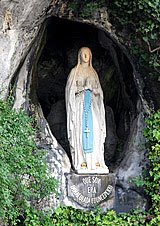
Our Lady of Lourdes

While we celebrate the feast day that honor Mary under the title, Our Lady of Lourdes, let us continue praying with words from St. Mark's gospel, (7:14-23). The words of Jesus contain something of the Marian message to St. Bernadette Soubirous at Lourdes.
Recently I read a reflection present by a former student. While working with native American Indians in the West, he learned much about himself from learning to work with clay. As Ray wrote, "Working with clay taught me the value of working on the inside ...." He saw much in molding clay that he used to see the process of transforming himself and, as a priest, others who sought his direction. He learned that to be successful in working with clay meant taking the time to help the clay become its very best. He learned that working the air bubbles out of the earthly mire demanding much squeezing, shaping, rolling. It was the only way to produce an object that would last.

What Jesus was teaching in this part of Mark's account can be put in a question: "Have you ever worked on yourself? To make ourselves better, to root out any demons that weaken our power as a son or daughter of God, does not happen quickly. No computer speed allowed in this process. The goal to be achieved demands much time. No athlete, not surgeon, no artist, no married couple became good quickly. If that did happen, most likely the product ended up being little more than a flash in the pan!

To work with what is within us we need the shaping hands of God. God, as you know, never hurries. Why a long time? Ask another question as well: Did your children, or children you know, learn "obedience, love, compassion, generosity and selflessness" quickly or easily? This question might suggest to adults when the very same virtues may yet be lacking in our lives. We may step back for trying to work on the inside being more concerned about the outside of who we are.
That's the message of Lourdes, even in the miracles: turn in on your very being. Come to know what God is trying to do with the graces he has given to you. Turn in on yourself.


Tuesday, February 10, 2009

"Hello Heaven; Goodbye Purgatory"

Depiction of St. Paul while composing ... seemingly in deep contemplation or in the midst of a composer's nap!


This might be one way of interpreting the recent articles that have come to parish bulletins in the Diocese of Brooklyn (NY) and in related Web sites that are focused on the "Plenary Indulgences."

The local Ordinary, Bishop Nicholas DiMarzo, brought the matter to the people of his diocese in the bulletin announcements. When asked by reporters why he was doing this, his response was simple: "Because there is sin in the world." Well, you certainly cannot say this Bishop is not speaking out against the prevailing evils in our world in our times. So, let's see what the local Shepherd is suggesting to his flock.

A teaching of the Church is this: through the Sacrament of Reconciliation or Confession, penitents are forgiven sins. However, the forgiveness of sins does not remove the "time in purgatory" for our sinfulness. Confession of a serious or mortal sin, however, does free a person for banishment to the regions of Hell. A person who is freed from the consequences of mortal sin or other sins through confession removes the sin but does not free that person from the obligation of atonement, the temporal punishment of sin --- time in purgatory.

Always mindful of its pastoral obligation, the Church extends to her people Plenary Indulgences, means to obliterate the temporal punishment due to God for our sins. Plenary Indulgences are granted by the Holy See usually on the occasion of a major event or celebration. Recently, on February 11th, the Archdiocese closed the period for a Plenary Indulgence that was granted for the anniversary feast of Our Lady of Lourdes. We are at the present time in the closing months of the Plenary Indulgence granted by Pope Benedict XVI to celebrate another anniversary, the commemoration of the Saint's 2000th birthday! This continues through June 29, 2009.

So, what does a person have to do to gain the benefits of a Plenary Indulgence? First and foremost, the person is required to go to the Sacrament of Reconciliation. Secondly, the person much receive Holy Communion. Next the person must make a pilgrimage (a visit) to a specifically designated church (although this does not pertain to elderly who are housebound as well as others who also for one reason or another area homebound), finally the person is expected to pray for the intentions of the Holy Father as usually expressed for the special Plenary Indulgence. Also, the person is expected to do all that is possible to overcome habitual sins.

For the Plenary Indulgence granted to us for the Year of St. Paul, Archbishop Wuerl designated the following churches* in the Archdiocese to fulfill the pilgrimage obligation:
Montgomery County:
St. Paul Church: Damascus
St. Catherine Laboure: Wheaton
Prince George County:
St. Hugh Church: Greenbelt
St. Mark: Hyattsville
St. Philip the Apostle: Camp Springs
Washington, DC
Cathedral of St. Matthew: Rhode Island Ave and Connecticut Avenue
Shrine of the Immaculate Conception: 4th St and Michigan Ave
St. Augustine Church: 15th and V Sts, NW
St. Luke: East Capitol Street, SE
Shrine of the Sacred Heart: 16th St and Park Rd, NW
Calvert County
Our Lady Star of the Sea Church: Solomons Island
St. Anthony: North Beach
Charles County
St. Ignatius Church: Port Tobacco
Holy Ghost: Newburg
St. Mary's County
St. Joseph's Church: Morganza
St. Michael: Ridge
Immaculate Heart of Mary: Lexinton Park

The upcoming Lenten season will afford all Catholics the opportunity to fulfill the obligation to confess their sins at least one a year and receive Holy Communion and to gain at least one Plenary Indulgence for him-/herself each day during the period of the Indulgence granted. The faithful can receive a Plenary Indulgence for a deceased person as well, fulfilling the expectations of the Holy See.