Tuesday, May 10, 2011

Wednesday Prayer

But God did hear and listen to my voice in prayer.
Blessed be God, who did not refuse me the kindness I sought in prayer.
Psalm 66

... whoever come to me will not hunger....
... I will not reject anyone who comes to me.
John 35 and 37

These two sets of words seem to indicate that Jesus spoke in words so close to those that King David had included in Psalm 66.  While today's gospel reading focuses on the Eucharist, "I am the bread of life" as the source of so much of the power and strength we are given by God, the words of the Evangelist John speak as did David about the goodness of God.  He is a loving God that cares about each of us.  When we come to God, Jesus or the Holy Spirit in our prayer, we are asking for graces, for blessings, for healings, for solutions more often than not.

In reading the full text of the psalm in the bible version used by the Bishops' Conference, there was a word added at the end of each small paragraph: Selah.  The word appears frequently in the Psalms.   It is thought to be a liturgical or musical directive either to life one's voice or to pause.  However, in using Google to search the meaning of the word, far from being a liturgical or musical director, I came across a selection of music that helped me in my dialog with God.  Let me share it with you.   Click on  to hear a a sung version by the artist Selah!

Press On
When the valley is deep
When the mountain is steep
When the body is weary
When we stumble and fall ...

When the choices are hard 
When we're battered and scarred
When we've spent our resources
When we've given our all

Chorus:
In Jesus' name, we press on
Dear Lord, with the prize
Clear before our eyes
We find the strength to press on

In Jesus' name, we press on
Dear Lord, with the prize
Clear before our eyes
We find the strength to press on
To press on

And where do we "find the strength to press on"?  Think a little and the Holy Spirit should be answering with thoughts about the Eucharist.  It is the "Bread of Life" that provides those who partake of the Eucharist with the abundance of graces to meet the challenges that we seek to meet or overcome in our lives.


The bread of life.  Jesus the Christ said that he was and will be forever the bread of life for those who follow him.  It is the gift each of us receives when we accept the Eucharist.  But there is a question that surfaces:  after receiving Holy Communion on any given day, what impact does that gift have?   Last Thursday I completed a five-day retreat.  It was one of the more powerful experiences in my retreat history.  Since that day, the impact has made itself felt throughout the course of each day thus far.  This is a tremendous gift, a reminder that the Holy Spirit is present each day.  When you receive the Eucharist on a daily basis, frequently or at Mass on a Saturday evening or Sunday morning, what is the impact of that experience?  Do you think about that gift any time later in the same day?  In the same week?  The gift of the Bread of Life, Jesus the Christ, should be more meaningful than anything.  To receive the gift of the Body and Blood of Jesus:  can there be any greater gift?  If this gift is not remembered for more than two or three minutes, what does that reveal about me, the individual?  Each Communion is a gift from Jesus himself, hand extended to the individual each time Communion is received.  Ask whether this gift truly means something very special?  The amount of time you recall the time in conversation with the Lord after receiving the Eucharist might be a sign to you of how significant this gift is to you!

Monday, May 9, 2011

A Quiet Place to See Yourself In Prayer or Reflection

In the readings for today's liturgy we come upon the longest psalm in the Book of Psalms.  King David incorporated 176 verses in this particular "prayer."  Perhaps you might need a bench like the one in the picture so that you can sit and read this psalm in its entirety.  In the New Jerome Biblical Commentary, the author points out that we need to know how David and many biblical writers used the word "understanding."  Of course there is the intellectual sense of the word.  However, David's use of the word, the biblical sense of the word, is to be understood as the "ability to see how all things in God's creation work together, and specifically how his commandments bring 'life,' the goal of all human striving."

Throughout the 176 verses, David's desire is to bring his hearers to know their relationship to God and his decrees, that we are to follow those commandments "with all [our] heart" to use the command issued in the Book of Deuteronomy.  He attempts to show that neither age, nor level of education, nor social status is the source of true wisdom.  Rather that gift comes from adherence to the divine commandments.

As you read through Psalm 119, you should realize at the outset that there is much to be understood in this lengthy prayer.  While it is not necessary to read the entire psalm, surely there is a taste of victory when it has been read!

This thought comes to mind:  today who would proclaim about God "how great Thou art," and, at the same time, have in mind the understanding that God's decrees for us are a part of his greatness?  We do live in an historical time when decrees by our Church and our civil governments are so often challenged.  Freedom of expression so often means freedom for everything.  David challenges his hearers and us who read his writings, especially this psalm, to "fear" the Lord, that is, not to "dread" him as a hostile being but rather to stand in "awe" before God and his decrees.

Once you have read the psalm in its entirety or just several of the verses, prayer time might be spent in speaking with God, and listening, too, about how Church decrees and the Commandments impact your life?  "God, you have given so much to me that I truly stand before in great awe.  How do I react or deal with the 10 Commandments or the teachings of our Church that are more like laws than not?  How does my inborn sense of freedom deal with this?

Saturday, May 7, 2011

You will show me the path to life
abounding joy in your presence.

These words of the psalmist, King David, are woven directly or obliquely into the three readings for today's sacred liturgy of the Eucharist.  As you see, if you read the first reading, Luke incorporates a part of David's psalm into the Acts of the Apostles.  He is trying to help the early Church capture the fullness of the Resurrection ... especially for those who may not have been alive when that event occurred.  For us today, let us pray that this Risen Lord will bless us with the wisdom to know the meaning for us in our world, our lives all these many years since Luke wrote.

In the gospel today, we once again embark upon the walk with two of the disciples who were running from Jerusalem. Fear of the enemy and disappointment.  Two emotions that could drive anyone away from an accepted purpose.  These two disciples were enduring a test of their belief?  Might you ask them in your own prayer how they felt?  How important was their faith to them?  Did they feel embarrassed when they realized that it was Jesus walking and talking with them?  Do you think the others were going to believe them when they returned with their "news"?  Would you believe them?

David's words of the verse should be read over slowly three or four times.  Notice the surety with which he speaks to God:  "You will show [me] the path to life."  There is no doubt in his mind and gives God no wiggle room.  "Your WILL show [me] the path to life."  Are you strong enough in your faith and personal relationship with Jesus that you can say those same words to him in your prayer?  Hmm.  A true test for us today.  Furthermore, Luke's words "the path TO life can help us talk more directly with the Lord.  David is not speaking about being shown the path OF life.  God is not giving the entire picture of life.  "Here's the path.  What are YOU going to do?"  Jesus might well be saying this to all of us in our own time.  Jesus WILL point out where the path begins.  Do you know where it has begun in your life?  Do you need to find the set out point again?

David gives his hearers and readers encouragement.  Realize that this path to life will ultimately bring you to a life  that is abundant with joy, on the one hand, and secondly in the very presence of God.  David gives such strong encouragement because he feels that only a foolish person would prefer something different to being in the presence of God.  Yet, most of us know how difficult it can be, this living the life of the gospels.  This is why Jesus so often told his disciples not to fear and why so often in the post-resurrection days emphasized peace, "Peace be with you."

David and others who accepted Jesus' invitation to follow him realized perhaps better than we do today that the Resurrection day, Easter Sunday, is the most important day in the year of the Church, in the life of our Church.  Christmas has a good purpose:  Jesus had to be brought into this world.  Good Friday had a reason:  to guarantee the forgiveness of sins.  Easter Sunday validates the promises Jesus made to all of us sinners who have come to seek his mercy, his forgiveness.  So, another question:  what does the Resurrection really mean to you?  Do you realize that without the Resurrection, all of the sacrifice of Good Friday would mean very little?


Jesus comes to the disciples ... "walking on the water."  You might ask  the writer of the account, John the Evangelist:  "What are your feelings as this happens?"  Were I John, I know my heart and my mind would be reeling.  "What can I do?  Where is our friend when you need him?  Will this storm do us in?"  Then, suddenly it seems, they hear "It is I.  Do not be afraid."  Because of Blessed John Paul II, we have become attuned to that second sentence:  Do not be afraid.  It was one of his frequent reminders to us about our safety in Jesus the Christ.

No doubt, someone or two of the disciples must have invited, called to or pleaded with Jesus:  "Come on, get in our boat."  Why not?  They had witnessed Jesus miracles before this.  We do not know  that Jesus came aboard.  But John gives us words of assurance that Jesus did something miraculous:  "... but the boat immediately arrived at the shore where they were heading."  How did this happen?  Lots of questions.  Maybe in your prayer or reflection you might ask Jesus something like "What was it you did?  Was it really 'immediately'?  What is it that you are teaching us?"

"Jesus, when I feel inundated, overwhelmed and asea, do I turn to you in honesty and simplicity?  Do I put out before you what is happening in my life?"   Aren't there the moments when I wonder if "I am always with you" is just another biblical saying?  Oh, perhaps I have forgotten:  did I ask you to come into my 'tossed about boat'? Do a talk and then LISTEN to you about my unsettledness? "

Are not moments like these true tests of my faith, my belief in what we have learned Jesus taught his disciples?  Am I asking simply to feel better?  Do I think to enter the conversation with Jesus, the Father or the Holy Spirit or a favorite Saint or Blessed with an openness of heart?  Does a quick "I believe you know" keep me from opening up what is in my heart and talking with him about it and THEN do I STOP to LISTEN ... just let my mind enjoy a relaxing freedom, enjoying a few moments with your guest in your "tossed about boat"?  Oops!  Sometimes I forget that part of the conversation:  I need to LISTEN, to hear what ideas come into my mind and heart.  Do I believe he will calm the waters ... perhaps not in the instantaneous manner as described in the gospel of John?  Do I trust him and realize he will ride out any storm with me?  Finally, do I realize I have to row my little boat, to work at understanding what it is I really need?  He will tell you.

Thursday, May 5, 2011

To get into the particular "gospel moment," imagine you are walking with St. John, the gospel writer, during the climbing of a hillside along with Jesus and other disciples.  Try to hear what Jesus and the others might be saying, especially when the realized a large part of the Passover crowd that was gather had started to follow after Jesus.  Why?  The news of miraculous "sign" or miracles for the sick would naturally draw all kinds of curiosity seekers.  Surely one or more of the disciples might have said what most of us today would say:  "Give the man a break."  Nevertheless after climbing the hillside, Jesus sat down with the disciples probably to take a break.  But the crowd pressed on.

Aware of the time of day and the crowd, Jesus knew they must have been hungry.  Surely they did not pack a picnic lunch/dinner for the occasion.  Jesus was more concerned about their hunger than being tired or the time of the day.  He did not grouse.  Rather he was concerned about giving them something to ease the pangs of their hunger.  Do you have a real, genuine confidence that Jesus  will answer your "hunger" when you feel the pangs?  Did you ever ask?  Did you take the time not to complain about the problem, the issue, but to simply ask "I need your help.  I have a particular hunger and I'm not succeeding in getting it to go away."  Have you been strong enough to admit your weakness?

You know the rest of the story in the "gospel moment."  With "five barley loaves and two fish" Jesus responded to the obvious needs that the disciples seemed to have missed.  Could we say that there have been times when we did not see the need, the hunger in others' lives?  Would we be like the disciples in the blindness, their seeming lack of concern?

In the responsorial psalm, Psalm 27, King David expresses his trust, his hope in God (vv.13-14):  "I believe that I shall see the bounty of the Lord in the land of the living."  He means the here and now not at some time after death.  Further he says "Wait for the Lord with courage.  Let your heart be firm and bold, and hope for the Lord."  We might not get instantaneous fulfillment.  But the King, clearly relating his own experiences, tells us "Be firm, be stouthearted at those times when your huger needs more than "five barley loaves and two fish."

Don't simply read these thoughts.  Hopefully they will help you speak to Jesus, speak with God the Father, speak with St. John who was there.  He is your risen Savior.  He is your God.  He came to save you from whatever "hunger" you might be experiencing.  Let him answer your hunger.  But you have to ask!

Wednesday, May 4, 2011

St John's gospel, chapter 3, verse 16:  The Evangelist writes "God so loved the world ...."  Now I would ask you to remove the word "world" and in its place insert the word "me."  Now read the sentence aloud ... if you can:  God so loved me ....  You might wish to repeat the words several times.  Let it sink in.  Then ask yourself this question:  What is there about ME that God finds me so lovable?  So lovable toward me that he would give "his only-begotten Son, so that everyone who believes in him might not perish but might have eternal life."  His love is so strong that he wants to save you.  Yes, he does but FROM WHAT? we might ask ourselves.

So there are two questions:  Why are you so lovable in God's mind and heart? and What is he saving me from?  Now, if you don't feel you can answer those two questions with any ease, stop you mental wandering around and ask him:  "Jesus, what is there in me that is so lovable?"  and then, if you cannot answer the second question, ask him again:  "Jesus, what is it you will save me from?"

You may recall someone saying to you "You are a caring person."  Thinking you might say to yourself, "Well, not so often."  Again, someone might say "You are a light-hearted person."  Again, you might say to yourself, "Well, if you only knew what was in this heart of mine."  And there are many such examples ... all as different as each one of us is from another person.


And do not forget John 3: 21: But whoever lives the truth comes to the light, so that his works may be clearly seen as done in God.  Here is the sentence of genuine reconciliation.  Ask God to see "the truth" and bring it to your vision, your light, so that you can see it as healing "done in God."

Tuesday, May 3, 2011

The feast day liturgy yesterday, Tuesday, presented portions of Psalm 19 for the Responsorial Psalm. The link is to the entire psalm which may be helpful.    Look a verse 1:  King David announces that the heavens tell us of God's glory.  The firmament put for his handiwork. So what does that mean to you?  Is it often that we think about this universe and ask "What is God telling us?"  Why did God make a day and a night?  What are these realities for you, for me?  Did you ever think that it is in the daylight that most speaking occurs and that in the darkness of night the mind and heart have an opportunity to think about what was said earlier in the day?  To me it is interesting that King David describes how God's handiwork keeps the universe in order and then turns to the ways God gives humankind what we could call his handiwork to humanity.  The moon, the stars, the sun, the oceans and rivers, etc. all play a significant role in the day-to-day "running of God's world."  At the same time, note what David writes about very real "structures" that keep humanity running:  the law of the Lord, the testimony of the Lord, the precepts of the Lord, the commandment of the Lord,  the ordinances of the Lord.  I suspect that at first reflection perfect law does not link to reviving the soul; the Lord's testimony making the simple wise, the hearts rejoicing because of the precepts of the Lord, the commandment opening up the human eye etc.  All of these King David writes are "more to be desired than gold, even much fine gold."  All of these divine creations both those that regulate the earth and those that guide humanity are around us 24/7 but do we even take five minutes to realize their importance and their giftedness to us each day?

Let's consider "the commandment" David mentions.  It is the first and greatest commandment.  You know that one, don't you?  "I am the Lord, your God ...."  The line stopped there purposefully.  Why?  What is to be garnered here is this:  It is to be understood as God saying to you and me, "I work for you."  Sound strange?  How often in Old and New Testament does God remind us  "I am here for you."  "I will walk with you."  We seem to forget that connection, don't we ... until someone asks us what that first and greatest commandment is and what its meaning is.
At the end of the psalm the King moves from praise of God's craftsmanship (!!!) to words petitioning God to not only take care of the universe and humanity, he asks that God take care of you personally.  Yes, direct care for you.  "Clear me from hidden faults....Keep presumptuous sins away for us, preventing their dominion over us.  And, lastly, let whatever I say or whatever my prayer might be that both will be what is acceptable in his sight.  And why all of this?  David sees in this great creative God a firm foundation rock and a redeemer.  Could you ask for anything better?

Ask the Lord for what you want, for what you need.  King David is asking God to be freed from whatever willful faults might damage our hearts and our lives.

Monday, May 2, 2011

The Nicodemus Moment

Our retreat director has said over and over "notice what you are feeling as you read or reflect on the words of sacred scripture because they are God's words and how you react to them can be significant for yourself."  Nicodemus meets Jesus and asks a few questions.  Imagine that you are standing there, listening to the conversation.  www.usccb.org/nab will link you to John's gospel, chapter 3, verses 1-8 if you wish to read the entire text.  Nicodemus responds to Jesus' words "Unless a man be born again, he cannot see the kingdom of God":  "How am I born again?"  How do you  react to what Jesus said to the man?  Does it seem impossible to you?  We men do not know how painful delivering a newborn is but all of us have heard either a wife, a sister, a mother or a friend speak of the sometimes too lengthy time the newest family member takes to come into the world ... at Mom's expense.  

So often we find ourselves at a point where we have been several times before.  Why is it that other realities  and emotions so easily take over our lives.  Why is it the rebirth is so hard for us?  What is it that frightens a person who is afraid to allow Jesus to take over his/her life?  There is usually a struggle to avoid what would damage our relationship with God but at other times there is no desire to change. "God just leave me be."  Living our Christian vocation to the fullest is fearful if we are honest with ourselves.  Being born again can be psychologically just as painful as Mom's hours of prenatal delivery.
What is lacking in moments such as these is conviction ... I am convinced that I want to live my life as God calls me to it.  In the spiritual life it is reading scripture, prayer and devotional practices that will constitute a successful spirituality.  

There are times when penitents will say to me and every other priest "I just feel so perturbed within.  I am just at an uneasy place."  When that happens, it is almost 100% for sure that the person has let his/her life be taken over by the evil spirits in the world.  There is a genuine need for being born again.  What we have to remember is that we might sin over and over despite efforts on our part not to do so.  Yet we are reminded that there was a one-time-for-all healing offered to each of us.  We just celebrated that reality during Holy Week which was validated on Easter Sunday morning by the Resurrection.

Live life to its fullest in and through Jesus Christ.  As Blessed John Paul II often said, "Do not be afraid.  Open the doors to Jesus Christ."  It is the call to open our hearts to our Savior.


Sunday, May 1, 2011

Open the Door!

Look again at the gospel for Divine Mercy Sunday, the Second Sunday of Easter Season (Jn 20:19-31).  Perhaps yesterday the focus was more directed to St. Peter's Square and the beatification of a Pope who touched the lives of so many people in so many different ways, a Pope who encouraged us time and again not to fear but to open our the doors of our hearts.

Look at the scene John recounts.  Consider this observation:  the opening scene may easily be understood as the experience of many people desiring to be what God wants of them.  It is a genuine expression of the human condition that confronts so many:  me?  you?  Don't many lock themselves in the room of fear?  Are not hearts often times unable to see what and where peace is and how we to live with it?  The disciples feared the Jewish authorities.  Consider this:  what each of us might fear is that Jesus will get into our my "inner sanctum,' that room  that protects private thoughts, desires and, yes, even failures.  Perhaps Jesus Jesus will use the same entry technique to gain access to our privacy if there is the slightest inkling that he will be allowed in.  If we allow entrance - a power that God has entrusted to us - he might say the same words and they would challenge:  "Peace be with you."
Before charging his followers he wishes to establish an atmosphere, a venue, that opens the heart.  Simple and to the point:  trust him, be at peace!  If peace is not the mood or reality in the heart, how can his command ever be fulfilled?  "As the Father has sent me, so I send you?"  What?  Send me?  Come on, I'm not one with all the necessary training.  Let's be real.

If we truly are willing to open our hearts to the Lord Jesus, only then will his peace be the wind that opens our sails so that we can go about our daily lives charged with the strength of the Holy Spirit just being the person that God wants of me and you.
------------------------------------------
This evening I have started a five day walk with the Lord on a silent retreat with ten other priests. In your prayers, please say one Hail Mary and one Our Father --sounds like a penance, doesn't it? -- for us that each of us will not be afraid to open his heart to the Lord's seeking to lead us where the Father desires we walk.

Divine Mercy Sunday: John Paul II Beatification


This picture is the man as I knew him ... older, saintly, truly carrying the cross of Jesus in his own illness and age.  The words that follow are from the Sermon of Pope Benedict earlier today as he celebrated the liturgy during which he proclaimed his predecessor, Pope John Paul II among the ranks of the Blessed in our Church.  No better words for our reflection.  EWTN will replay the Mass at 8 PM EST today.

Today is the Second Sunday of Easter, which Blessed John Paul II entitled Divine Mercy Sunday. The date was chosen for today’s celebration because, in God’s providence, my predecessor died on the vigil of this feast. Today is also the first day of May, Mary’s month, and the liturgical memorial of Saint Joseph the Worker. All these elements serve to enrich our prayer, they help us in our pilgrimage through time and space; but in heaven a very different celebration is taking place among the angels and saints! Even so, God is but one, and one too is Christ the Lord, who like a bridge joins earth to heaven. At this moment we feel closer than ever, sharing as it were in the liturgy of heaven.

Dear brothers and sisters, today our eyes behold, in the full spiritual light of the risen Christ, the beloved and revered figure of John Paul II. Today his name is added to the host of those whom he proclaimed saints and blesseds during the almost twenty-seven years of his pontificate, thereby forcefully emphasizing the universal vocation to the heights of the Christian life, to holiness, taught by the conciliar Constitution on the Church Lumen Gentium. All of us, as members of the people of God – bishops, priests, deacons, laity, men and women religious – are making our pilgrim way to the heavenly homeland where the Virgin Mary has preceded us, associated as she was in a unique and perfect way to the mystery of Christ and the Church. [Pope John Paul] was fully aware that the Council’s decision to devote the last chapter of its Constitution on the Church to Mary meant that the Mother of the Redeemer is held up as an image and model of holiness for every Christian and for the entire Church. This was the theological vision which Blessed John Paul II discovered as a young man and subsequently maintained and deepened throughout his life. A vision which is expressed in the scriptural image of the crucified Christ with Mary, his Mother, at his side. 

Finally, on a more personal note, I would like to thank God for the gift of having worked for many years with Blessed Pope John Paul II. I had known him earlier and had esteemed him, but for twenty-three years, beginning in 1982 after he called me to Rome to be Prefect of the Congregation for the Doctrine of the Faith, I was at his side and came to revere him all the more. My own service was sustained by his spiritual depth and by the richness of his insights. His example of prayer continually impressed and edified me: he remained deeply united to God even amid the many demands of his ministry. Then too, there was his witness in suffering: the Lord gradually stripped him of everything, yet he remained ever a “rock”, as Christ desired. His profound humility, grounded in close union with Christ, enabled him to continue to lead the Church and to give to the world a message which became all the more eloquent as his physical strength declined. In this way he lived out in an extraordinary way the vocation of every priest and bishop to become completely one with Jesus, whom he daily receives and offers in the Eucharist.
Blessed are you, beloved Pope John Paul II, because you believed! Continue, we implore you, to sustain from heaven the faith of God’s people. Amen.

------------------------------
My own personal note:  yesterday, as I posted a reflection and request for prayers, my friend, Jim Peck, was brought home to his God.  Your prayers surely helped him in the final moments of his life and helped open the heavenly gates for his great reward.

Saturday, April 30, 2011

"Go into the whole world and proclaim the Gospel to every creature" (Mark 16:15).   When some of Jesus' disciples had a hard time believing the reported appearances of others of the disciples on the Easter Sunday, Jesus appeared to the whole group and "rebuked" them for this unbelieving attitude.

It has always been and perhaps will be forever that some people will have a difficult time believing the Resurrection story.  In the Acts of the Apostles the officials needed to quell the proclaiming of John and Peter because there were some who did believe in a miracle brought about in the name of Jesus.

Today, in our advanced technological world, it is not unusual to hear someone say, "I really have a hard time in believing there is a God."  We might ask how that position can come about.  If there is no reading, reflection or prayer -- no breaking open of the scriptures -- is it surprising the marvelous "miracles of technology" would replace the Divine Being who created this world and all of us in it?

There is no doubt that the lack of prayer and reflection over Jesus' words in the New Testament make it very easy to forget the God of both Old and New Testaments.   The words of King David in Psalm 118, verse 21, today's responsorial psalm need to be heard:  "I will give thanks to you, for you have answered me."  Why?  Because of one word: "answered."  That means I have asked a question!  And you?

Friends, please remember in your prayers today, a man, Jim, who has struggled so nobly over the last several months with cancer that settled in his brain.  Similar to what the late Senator Kennedy endured.  Jim has been so gifted by prayers over this period of time.  This morning, I read an email from someone who is close to him with the information that Jim had to be rushed to Georgetown because of bleeding in his brain ... that is inoperable.   That word, inoperable, is so heavy.  Remember Jim, his ever-dedicated wife, Cecilia, and their son and daughter-in-law who have suffered so much heart pain during this year.  Thanks.  Just a simple petition to the God you talk to is all I ask.  Thanks.

Wednesday, April 27, 2011

The NAME of NAMES


When we need something beyond our own reach, we call out to someone:  "I need a letter of recommendation."  Can you help me get the job I want?"  Just two statements that reveal a genuine human need:  someone besides myself has more power than I have; someone else can make the difference I can't make.

Whenever we are down and out:  we call upon a name!  Peter and John witnessed an event that shows us the one name that is power, that is the difference maker:  And by faith in that name lives are changed, visions take on reality, hearts discover true peace.

Long before our time there was a man who knew that name and knew it well.  Listen to King David:
"O Lord, our Lord, how glorious is your name overall the earth."
Psalm 8

Monday, April 25, 2011

"Space Travel of the Heart"!!!


Surely some must have questioned at one time or another how the disciples related to Jesus after his Resurrection.  Today's gospel selection brings us to the Evangelist John's account of how Jesus first appeared to one of his disciples, Mary Magdalene.  For some time this Mary could not leave the tomb because "They have taken my Lord ...."  Through the blurry vision created by her tears she peers into the empty tomb, and hears one of the two angels ask why she is crying.  According to John, as soon as she answered that "they have taken my Lord," she turned around, perhaps distracted by a noise, and saw a man there who was Jesus.  However, she did not recognize him.  Jesus speaks to her, again presenting a question about why she was crying and who it was that she was seeking.  After asking the man, presumed by Mary to be the gardener, Jesus speaks her name.  Immediately Mary responds: "Rabbouni!"  She must have reached out to take hold of him because he tells her not to touch him "for I have not yet ascended to the Father."  Clearly how the Twelve and the close disciples had related with Jesus is no longer possible.  As St. Paul writes in 2 Corinthians 5:16-17,  "Even though we once regarded Christ according to the flesh, we regard him thus no longer... he is a new creation.  The former ways of companionship with Jesus were, it seems, over.  She cannot touch him because he had not yet returned to his Father.  And that very expression seems to indicate that Mary and all of us can  touch this Jesus with the Father.  As Pope Benedict has written:  "If we enter fully into the essence of our Christian life, then we really do touch the risen Lord, then we really do become fully ourselves."  "Seated at the right hand of the Father (from the Creed)," the risen Jesus is not far away from us.  And, please note this: that distance whether it be far or near is not a measurable distance.  The Pope displays, I believe, his own sensitivity and genuine spirituality when he wrote "And this path is not a matter of space travel of a cosmic-geographical nature:  it is the "space travel" of the heart ...." 

And Tomorrow?


The Resurrection day has already passed us by.  Now most folks have returned to the customary routines of day-to-day living.  And what impact, what spiritual change did the recent Lenten journey make to your life?

Early this morning a TV commentator said that successful people will tell you that it was the failures in their efforts that helped them become what they are today.  Do you apply this norm solely to the non-spiritual aspects of life?  Do you ever stop to consider that spiritual failures seem to weigh down folks with a sense of guilt or a feeling  that does not help rebuild for future successes?

What was the "impact" of Jesus' Resurrection for you?  Does it mean anything in particular for the vocation you proclaim if you say "I am a Christian"?  In the gospels the Evangelists recount events or moments when the Risen Christ tells one or others to go and tell the Good News that I have risen.

You may not be called to be a professional preacher.  Yet, by your Baptism, your Confirmation and the many times you have received Holy Communion you have been called to make know the reality of a Resurrection-based faith.  And how do that?  The way your witness Jesus' Resurrection graces in your life, especially how you demonstrate the reality of hope in what you say or do.  Did the days of this past Lent invite you to a new and deeper understanding of the Risen Christ who is at the heart of your faith?
Keep me safe, O God; you are my hope.
I bless the Lord who counsels me;
even in the night my heart exhorts me.
I set the Lord ever before me;'
with him at my right hand I shall not be disturbed.
(Psalm 16)

Sunday, April 24, 2011

The Resurrection of Jesus Christ


If Christ has not been raised, then our preaching is in vain and your faith is in vain.  We are even found to be misrepresenting God, because we testified of God that he raised.
(I Cor 15:14-15)
Today in liturgies throughout the world the word often heard is “resurrection.”  Today is the day the Christian world celebrates and rejoices:  It is the Resurrection of the Lord Jesus Christ.  The words of St. Paul could not be clearer.  This is the message of faith for the Christian professing the faith.  If ever anyone wished to do away with the Christian belief, it could only occur if it could be proved that Jesus did NOT rise from the dead.
If the Resurrection were removed from the Christian story, what would remain?  What we would have would be a collection of stories and events about God and humankind.  We would have another religious world view.  The reality would be this:  “The Christian faith would be dead” (Pope Benedict XVI).  Furthermore, the primary character in the story would be “a failed religious leader.”  The Jesus role would be a “purely human” event in world history.  A failed leader would not serve as a standard for Christianity.  Only then could we opt for certain aspects of his life, “his heritage,” as norms for our own lives.  We would be without a model that has nothing like it, equal to it or even better than it.
Only the Resurrection, Jesus risen from the tomb, changes world history.  Repetitious world religion history would not be changed if Jesus had not risen from his death.
It is the Resurrection that actually teaches us who this historic figure was and continues to be.  To best understand this extraordinary moment that truly changed human history, we must “listen” to the words that come to us from the New Testament.   So we have to ask ourselves what truly happened.
From all accounts that we possess in the Scriptures, Jesus did rise from the dead and appeared to some witnesses in a period of time after his rising from the grave.  What they experienced in this visitations was far beyond anything they had ever experienced.  Even though they were compelled to tell others who had joined them in their allegiance to Jesus, these appearances were far beyond anything the had ever experienced.  It was only in these experiences that the disciples could begin to understand the uniqueness of this event.
We know from the New Testament gospel accounts that “the miracle of resuscitated corpse” was very different from the “equivalent” to several events similar to this:  the raising of (1)the son of the Naim widow; (2) Jairus’ daughter; and, (3) Lazarus.  What we know about this three people is that they did return to a regular life and at another point in time their lives ended in a natural death.
With the Resurrection of Jesus, we encounter something very different.  Almost 2000 years later we know this:  Jesus did rise from the dead like the examples of other those just mentioned but we have never had a record of his continuing his life as usual nor did he ever die again.  What the Resurrection teaches us is that Jesus’s Resurrection was about his “breaking into an entirely new way of life.”  His new life was no longer constricted by the natural laws of becoming and dying.  His rising put before the world “a new dimension of of human existence.”  His  rising was what Pope Benedict XVI calls an “evolutional leap.”  His Resurrection is not considered an isolated event, limited to the past.  Rather, in Jesus’ Resurrection there is a new possibility for human experience.  Furthermore, it impacts not only Jesus but every human being created by his Father.  His Resurrection present each of us with a “new kind of future.”
St. Paul, again writing to the Corinthian community, makes clear that Christians now have an inseparable link with the Son of God in and through his Resurrection.
What we give witness to in our celebration of this unique moment is that Jesus’ Resurrection is a “universal event, or it is nothing.”  Jesus has returned to be among us but not in the “normal human life in this world like Lazarus” and others he raised from the dead.   With the Resurrection, Jesus has rejoined the life of God, the life of his Father.  It is from this new life that he has come to meet his friends.  Through this great event, his followers and all humanity has reason “to believe in Jesus as the Son of God.”
The quoted words and phrases are from Pope Benedict XVI’s Jesus of Nazareth, Part Two, published just several weeks ago.

Good Friday 2011

During this season of Lent, you were invited to read at least one of the four Passion Narratives, as the accounts of the Evangelists’ presentations of the hours that Jesus spent hanging on the cross and his death.  Perhaps you may have noticed or sensed that these accounts seem to repeat or refer to words that you have heard from the Old Testament.
What happened in this realization is what happened for the whole Church: the written and spoken word of God that came from the prophets especially are on Good Friday afternoon linked to the event that took the life of Jesus.  What had been considered words from God through the prophets which in some cases were not as clear as we would have liked them to be now in one three hour period become reality.  The meaning of all that the prophets wrote or said are unlocked with those final words, especially, “it is finished.”
We have progressed so far from the days of Jesus’ death.  Imagine if you were a part of that early Church that began its formation and building up after the death of Jesus.  At first most of the followers of Jesus just could not understand what had happened ... all the promises seem to have become subject to questioning.  Remember what happened on Easter Sunday afternoon with two of the disciples who were getting out of town on the way to Emmaeus.  Their hearts were in great darkness.  They were frightened that they might be hunted down.  Their hopes were dashed.  But and extraordinary event took place during that journey:  Jesus walked with them and explained “all the Scriptures”  -- all the Old Testament writings.  They realized that what they had considered as preposterous in what Moses and the Prophets had predicted now had happened.  Suddenly their eyes were opened.  What was seemingly so absurd, now had a meaning almost beyond belief.  They realized during their journey that it is in going from one point to another is the only way for an individual to come to understand  the power of evil.
If you have the time during the day tomorrow, I would offer a suggestion you might incorporate into the final day of your Lenten Journey.  Try to place yourself in a pre-Crucifixion mindset.  Read slowly and carefully the words of the 22nd Psalm.  That psalm is the cry of Israel as it was written ... but now, on a Good Friday evening,  it portrays for us the incredible gift that Jesus gives to the Father for you and for me.  It is his anguish.  It is his crying out.  And then it is his promise of a new meal, the Eucharist he has given to us with his very life.
Likewise you might consider reading the 53 chapter of the Book of Isaiah.  In the words of this prophet’s heart you will walk step by step along the pathway that Jesus followed.  Here the prophet speak and writes words that are so much like an Evangelist, a proclaimer of the Good News.
Let us recall when you receive the Eucharist it is indeed the fulfillment of God’s promise to the people through the Prophets to bring us to a new life.  

Thursday, April 21, 2011

Holy Thursday, Good Friday and Holy Saturday


See from his head, his hands, his feet
What grief and love flow mingling down;
Did e'er such Love and sorrow meet,
Or thorns compose so rich a crown?

Were all the realm of nature mine,
That were a present far too small;
Love so amazing, so divine,
Demands my soul, my life, my all.

AND YOUR RESPONSE?

Tuesday, April 19, 2011

Wednesday: In Your Great Love!

Today's Responsorial Psalm response:  Lord, in your great love, answer me.  How many times in your journey of faith have you found yourself on the wrong road?  That unreliable map!!!  Realistically we cannot blame "the map."  The challenge is to face our own weakness. Each time we sin are we not like Judas -- somehow co-opted into taking a different turn, a change in direction.

During the next three days, as you pray or simply give time to God to hear his voice, be mindful of the specific times you have opted for what is sinful, what adds to the pain and suffering of one innocent man who freely agreed to endure the torture and agony that would reconcile you to God. 

Mindful of such a gift from God, don't the words of the 69 Psalm have so much more meaning for you?  :Lord, in your great love answer my plea for the graces to endure the shame I feel for my sins.  Lord, answer me.

Value of a Promise

"I will lay down my life for you."  These are strong and meaningful words for the leader of the group gathered with Jesus for what will be their last supper together.  Today's gospel.  Peter, surely very close to Jesus, announced his pledge of fidelity clearly.  Yet, as we know, within just a very short time -- maybe two or three hours -- the good intention was lost.  As we read this and ponder the words and the scene, we might ask ourselves this question:  has there been a time or times in my life when I have made such a pledge to Jesus Christ?  That answered, the next question follows:  have you had times, as Peter did, when you pledge was rejected for something or someone other the Jesus Christ?  Was your heart hardened?  Was your heart divided?
We know that Peter admitted his error, his guilt -- unlike his colleague, Judas who could not face up to his betrayal.
The hours of Holy Week that remain are moments when we can honestly and quietly manifest our failures and lament what sin has done to our lives.  These are the moments when we can truly speak to the Lord about our past and express our sorrows meaningfully.  Likewise it is a time when we can give God thanks for the gift of reconciliation.

Monday, April 18, 2011

Challenged Again

"What I just did was to give you an example:  as I have done, you must do." (John 13:15)  How many times have we heard the account of Jesus' washing the feet of his closest followers or witnessed the enactment of the moment during the Holy Thursday liturgy?  Perhaps more often than we can count.  If we were asked to write down what Jesus' reason was in doing such an action, how would you respond?  Imagine a young teenager hearing the story read, turning to you with this question:  "So, what's so significant about this story?  He washed their feet."  Presenting an answer to a younger person's inquiry is very productive because we must understand the answer in its simplest terms.  In short we have to have realized its meaning for us in our lives.

"It is easier to talk a good game than to play the game well" is the answer Bishop Robert Morneau suggests.  What the actions fo Jesus signify is that he focuses upon the "gap between doing and saying."

My Dad would often use the well-know and well-worn sentence:  "Do what I say, not what I do" when we challenged a command.  So, here Jesus is simply saying to his disciples and all his followers is this:  I am going for you what I have told you is the Fathers' will for us.  In the washing of others' feet, an act of great humility in the Jewish tradition, Jesus is teaching those who want to be like him to be what you profess to be.  A true follower of Jesus cannot be a "Sunday Christian" and then a "Monday to Saturday hypocrite."

Throughout his life with us Jesus spoke many times about goals and then practiced them himself.  How many times did he speak about the reason he came to our earth, to be one like us in everything except sin, to care for the poor -- the materially poor as well as the spiritually poor; to forgive those who have harmed others or ourselves; to love those who very being was ignored or injured?

During this Holy Week, especially during the Three Sacred Days (Sacred Triduum) we should consider this question:  what teaching of Jesus truly challenges me?

Saturday, April 16, 2011

Palm Sunday

In the gospel for the Palm Sunday there is a marvelous presentation of the mysterious complexity that makes human beings who they are.  In Matthew’s account of the life of Christ, his gospel story, prior to the time when Judas is presented thirty pieces of silver, Matthew includes how a Bethany woman used precious oils to anoint Jesus.  This was an action that disturbed the disciples since the oil was not inexpensive.  Clearly the lady was mindful of what was happening in Jerusalem, how the Sanhedrin officials were making plots to have Jesus killed.  She knew he would be treated with great torture and pain.  So, using such valuable oil seemed to the disciples to be a careless use of the resources.  Nonetheless the woman would not let the cost challenge her generosity.

Then Matthew puts forward the picture of Judas.  He was a follower, supposedly a very close follower of Jesus.  His heart, however, was a hardened heart so very different from the kindness of the woman who anointed Jesus.  Greed and treachery had become on Holy Thursday evening the hallmarks of Judas’ heart.

What the various liturgies and the scripture readings used at the liturgies during Holy Week are presented to us to accomplish in our hearts a better understanding of the mysterious light and darkness that can take over a human being’s heart.  As we reflect on the words of the various gospels and consider what Jesus is doing for each one of us, we are opening our hearts to the process of lamenting.

Lamenting:  will you lament at all during this week?  Some might ask this question:  “Well, just was does lamenting mean to me?  In rather simple terms lamenting is meant to be the opportunity to move our heart and minds to an understanding of our own human complexity, especially as it related to our sinfulness that brought about the suffering and death of Jesus Christ that we reconsider during during the painful last week of the life of Jesus.  Why?  We need to embrace the darkness ... the darkness of our own sins that has either separated us from our God or has allowed us to do damage to our sisters and brothers but especially the pain and torture our sins have brought to the Son of God.  Beyond embracing  the darkness of sin, we have to admit that sin has had its hold on me, on you.  And we have to realize that we have been granted the graces to let go of it.  We cannot keep within our hearts the burden of  guilt that wears us down.  We have seek the grace to let go of whatever sins there might have been that keeps me apart from God.

This week we will revisit the reality that Jesus was strong enough, graced enough by his Father to embrace that same darkness ... the darkness that is yours and mine ... and reshape it into generosity.  What we can gather from St. Matthew’s gospel is Jesus’ suffering and death were for him the means to change that darkness into light.  Greed will become generosity again; death will be renewed life.

At the Threshold


This morning we are at the threshold of Holy Week.  Jesus and some of his disciples are making their way to Jerusalem, the holy city, to celebrate the Passover.  At the same time the officials of the Sanhedrin were discussing Jesus' growing power among the people and its potential for their ruination by the Roman authorities.  These power brokers would certainly do much to change the power structure in Jerusalem if Jesus continued to bring so many to himself and his mission.  So in session with the other leaders of the Jewish people, Caiaphas prophesied that Jesus would have to die for the good of the nation so that a divided and dispersed people would not be a reality.  

As we begin Holy Week later this evening and throughout the days ahead let us remember and live a few particular thoughts:  (1) Jesus was willing to suffer painfully and die; (2)   he would reconcile each of us, sinners that we are, to God the Father;  and  (3) discipleship with Jesus is a costly reality.  We are called to climb the Calvary hill with him not in this one week alone but every day of our lives; every time we find ourselves willing to fall victim to the temptations that are put before us.

How often have we had this thought:  Jesus' "dying is our death" (Bp Morneau).   We, as his disciples, are called to share in his death.  But there is more.  We are given an invitation to the new life guaranteed by his rising from the tomb of death.

We might ask ourselves "Does this terrible death have any genuine meaning in my life?"  If it does, why is this so?

Thursday, April 14, 2011

The Gift of Eternal Life

"...whoever keeps my word will never see death."
John 8:51

The opening verse for today's gospel, quoted above, can be confusing especially to younger people and others who might not have had the advantage of biblical teaching or studies.  Jesus is not speaking of physical death.  Thus far in human history there has not been the first human being not to have died -- except those of us currently on the face of the earth who just do not know when the final moment of life will be.  We know it is coming at some point in the future.
Most of us know that Jesus is referring to eternal life.  WE will die but for those who have embraced the life that God puts before us there is Jesus' promise of eternal life ... a new life, a different life.  It is through the Paschal mystery that has brought to us the gift of eternal life with God in his kingdom.

As we approach the beginning of Holy Week and the opportunity of walking with Jesus through his suffering and death, we are given the opportunity once again to further understand appreciate the graces of the eternal life that has been given to the entire world by one man's death.
The photo above is from a banner that hangs outside the Walters Gallery in Baltimore, MD.  At the present time there is a display of "reliquaries" and several other ancient items that were used throughout the centuries to encase a part of a person's body, a relic, or that contained an oil or water or a piece of cloth that had touched the body or a relic of a holy person, usually considered a saint.  It is a marvelous display of ancient handicraft and a reminder of a practice still held as sacred in our Church today.  Until recently a part of the process of canonization of an individual to be raised to the dignity of sainthood, when the person's coffin was opened, a bone from the leg, arm or hand was removed and used to prepare many very tiny "first class relics" that would be inserted in a reliquary.  This would then be made available to the faithful and used to seek the intercession of the saint in seeking miracles for individuals who might be sick, infirmed, etc.  If you are in the Baltimore area, the visit is worth the time to learn more about specific individuals whose relic has been encased in a reliquary and to see remarkable craftsmanship that produced these items.


Wednesday, April 13, 2011

Living in God's Word!

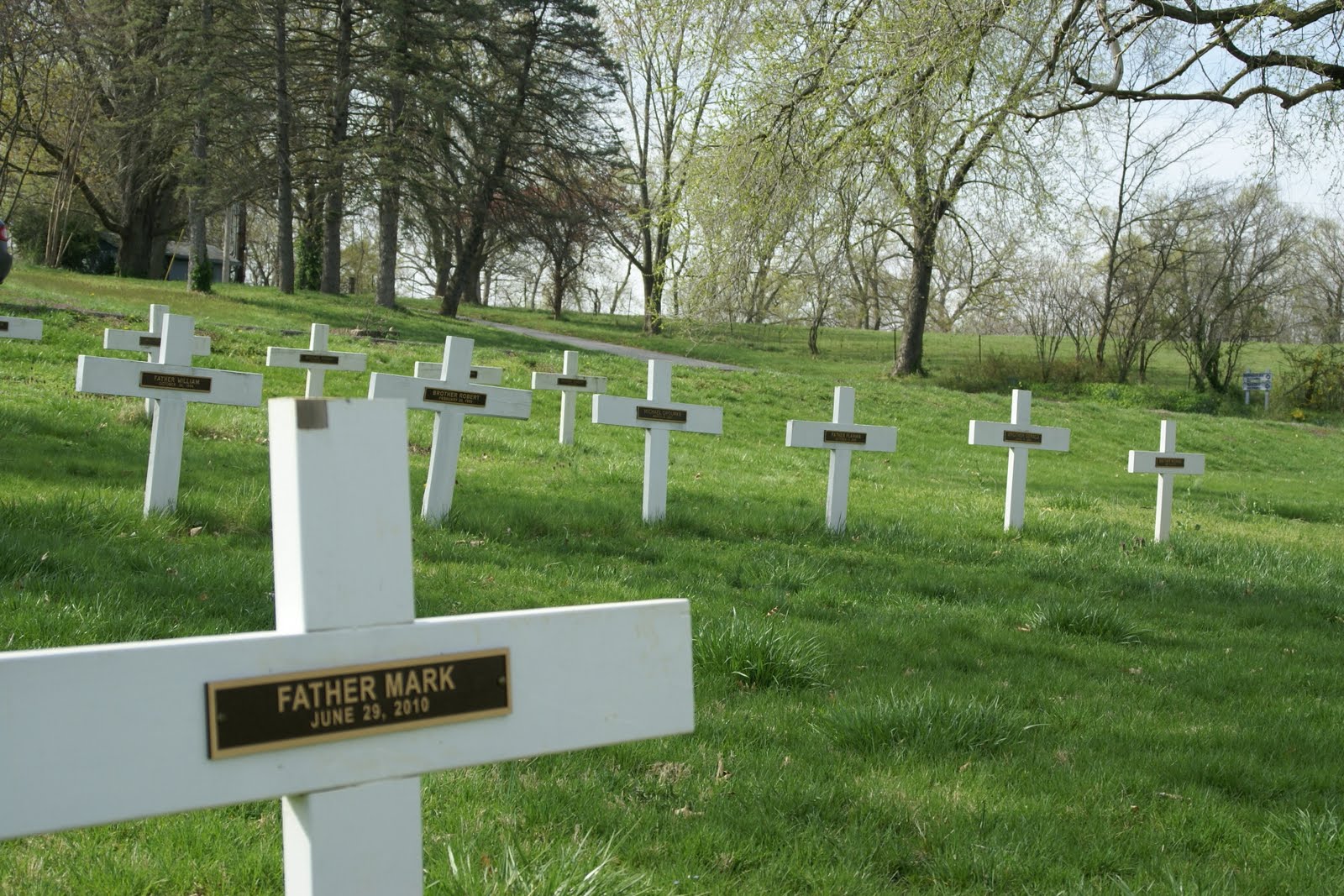
Portion of the cemetery at Holy Cross Abbey, Berryville, VA

If you live according to my teaching, your are truly my disciples;
then you will know the truth,
and the truth will set you free.

Jesus presents another human reality to the people following him that is as real today as it was when he spoke those words.  It is this: IF a certain condition exits, THEN there will be specific results.  IF you walk in today's showers without an umbrella, THEN you will get wet.  IF you eat and exercise properly, THEN your body will be in good shape.  IF you pay your taxes properly, THEN the IRS will not bother you.  Our lives are little else than IF....THENs.  We have to face the reality that IF we wish to achieve anything, THEN we have realistic criteria to follow.  IF good vision is to continue for many of us as we grow older, THEN we have to have our eyes checked and wear the prescribed eyeglasses.

Today's reading speaks about a kind of seeing, a kind of understanding.  IF we want to remain in God's word, we have to follow Jesus' teaching.  First, what is this reality God's word?  An  example will help answer:  When I was a Sophomore at Gonzaga High School in Washington, DC, my history teacher was very clear about a weekly assignment that had to be (1) turned in every Monday at the beginning of the history class; (2) the assignment was to prepare a synopsis of the next chapter in our history text book (everyone was lengthy, I assure you); (3) the paper was to be typed -- it was 1961, mind you; (4) the front page format the teacher put forward was to be followed precisely -- with the student's name in the upper right corner; and  (5) every misspellling -- again remember for spell check --- resulted in a one point deduction from the final grade for the paper.  As students, we knew the teacher was very demanding.  So, to be in his good graces when he marked our papers, we knew we had to follow the directions precisely or we were not in his "word."

To remain in God's word is an easy assignment to understand:  follow the teachings of the Father's will for us as presented by his Son, Jesus Christ!  Fortunately for us today, we have a spiritual spell check, we have computers and excellent word processing realities and we have remarkable communications that make the word of God clear for us us, understandable and available.

 It boils down to this, I believe: "IF I accept God's role in my life, THEN I will know true freedom.  So, philosophically speaking -- a phrase rare from this man's mouth -- the "word" is the dwelling place of being.  What?  In your experience there have been men and women you may have described as "She is a holy woman; or He is a holy man."  There is just something about him, about her, that clearly signals sanctity.  His/her "word" is an external presentation of his or her very being.

So, IF you want to live in God's word, THEN you need to live the teachings, the gospel of Jesus Christ.  IF we live a good life, if we do all that is in our power to live the life God has called us to live, THEN we believe a life with God in his kingdom will be a reality.  Human death will not be something we have to fear!  We know then that we will rest in peace!

Monday, April 11, 2011

Tuesday: The Pain of Solitude


There exists within the human being a tendency to belong, to be a member.  What does this say about us?  Perhaps it is loud and clear among most of us:  SOLITUDE IS SO PAINFUL.

Jesus said (in today's gospel)
"I belong to what is above.
Your belong to this world..."
(John 8:23)

Why, then, did Jesus agree to leave the Father and the Holy Spirit to become a part of our world, to join us on our journey?  Is the heavenly kingdom empty?  boring? dull?

Jesus joined us for a specific reason:  he, along with the Father and the Holy Spirit SO LOVED YOU, me and every child of God that he wanted to take us and our world into his punctured hands -- and our sin-damaged world to guve us to the Father and to give us the heavenly kingdom.
D you find this difficult to accept or believe?  If so, quite simply and straightforwardly, that is living in a world of separation from the Creator.  You and I, we were God-designed and for a singular purpose:  we are made for God.  In you annot accept this reality, do not be surprised by a life of unrest, a world of struglle.
And what then is our basic and ultimate orientation?  The answer is one word:  GOD!  Or in a simple sentence:  I belong to the Creator God.

Truth and Compassion

"The Almighty has planted His see in the earth:
He tended well the grain, he waits for [our] rebirth"

(Didier Rimaud, found in Breviary, Vol II, p 42)

The Lenten season is an annual time for the evaluation of the soul's harvest and the turning of the heart's soil to receive the seeds of God's graces.  It is the season when we should carefully look at and listen to the greatest of teachers, Jesus Christ.  Today's gospel presents Jesus as unique teacher.  We might ask ourselves what are the lessons, the graces of the Holy Spirit that are opened in my heart today and every day.

As a follower of Jesus Christ, in whatever vocation we follow, it is the teaching by example in my every day life that will break open for others those moments when they recognize in us the values of Jesus Christ.   We might ask ourselves today "What do people see in my example?"  Is it someone like themselves?  Someone better?  Someone they want to follow or whose ways they want to imbed in their own lives?  Being an example to others, modeling one's life on Jesus, what might my conversation be on a regular basis?  Is it too down to earth?  During his lifetime, Jesus often spoke to others without vulgarity, without gossip.  His words were always expressions of truth and compassion.  Even his challengers recognized power in his words:  "... he speaks with authority."

The power of a follower of Jesus is to be seen first in what he/she "does" then in what he/she "teaches."  It is my actions that will ultimately be embedded in the hearts and minds of those who know me.  Yesterday in the Washington Post there was an article by a Catholic man who wrote about the person(s) he considered his best teacher(s).  It was not their genius, although he admired how much knowledge was put before him in class.  No, it was simply this:  that teacher was the religious sister and the Jesuit seminarians who taught him what was critically important was always being available to the student(s).  What the writer came to learn is that each day needs spirituality as well as learning; each life needs the effort to help another as well as care for one's self:  like Jesus the teacher of truth and compassion!

Sunday, April 10, 2011

Jesus Wept


When Jesus saw her weeping and the Jews who had come with her weeping,
he became perturbed and deeply troubled, and said,
“Where have you laid him?”
They said to him, “Sir, come and see.”
And Jesus wept.
John 11:33-35

What are we invited to experience in these words of St. John's gospel?  Simply put:  the humanity of the Son of God.  Weeping so often is perceived as weakness.  When there is the death of a friend or loved one, many experience the need for a handkerchief or tissue paper.  Is there something more than loss that brings about the moist eyes?  What do we call it?  Sympathy or concern, perhaps compassion.  Perhaps we might have a deeper insight into ourselves and into Jesus if we look upon this event in Jesus' life and the various similar moments in our own lives as solidarity, sharing the pain of another person.

In today's gospel verse we look upon the pain of loss that Martha and Mary are enduring because their brother, Lazarus, had died.  We also are invited to read two words that speak volumes about Mary's son: Jesus wept.  We stand watching the man whose heart is moved by the loss of a friend and the overwhelming confusion of the dead man's sisters.  It is clear Jesus is feeling the sisters' loss and their personal concern about their future:  what lies ahead for them.  This moment in the life of Jesus is much more than our viewing him in tears.  We are watching the Son of God in one of the sadder moments human beings experience.

There is another time when "Jesus wept."  From a vantage point outside the city of Jerusalem, Jesus looked out to the city and he wept.  Why?  What did he see?  He saw the confusion and the loss of so many people.  Imagine what Jesus would do today were he in any city of our world today.  Perhaps he would weep.  More likely he would sob as he would look upon so much evil, so much hatred, so much war in distant lands as well as in families and communities.  What is the reality that brings him to this emotional state?  His mission.  Jesus knew he was sent by his Father to bring sinners from their confusion and loss to salvation.  What he saw and would see today was and is overwhelming.  Look closely!  You see the infinite compassion that rests in the heart of the Son of God.  What you see in these events is Jesus being one with humanity.  Solidarity!

This is what the Pastor of the parish where I reside is doing this weekend.  Last week he challenged parishioners to seek out a friend or relative who had fallen way from practicing his/her religion.  The parishioner was asked to invite that person to return with the parishioner to one of the weekend Masses.  We are challenged to see the confusion and loss that may be filling the heart of that friend or relative and to bring him/her to know once again that Jesus has wept for him/her at some point in their lives of distance from his Church.

Without doubt that exercise, if practiced, surely is a fellow Christian and Catholic seeking to demonstrate personal love and compassion for a friend or relative.  This exercise turns tears of sadness into tears of joy.  Hopefully the returning person will find the grace of reconciliation a genuine experience in love and peace -- the love and peace of Jesus Christ.