Tuesday, September 21, 2010

Wednesday: Turned Tables

For sure many people, perhaps family and/or friends are truly struggling to survive in today's economic misery.  One time McMansion dwellers are mow living with relatives or friends or in dthe least expensive housing available.  There is no other way to describe this current American picture than these words:  "the tables have turned."

St Ignatius of Loyola wrote in letters and general directions to his army of Jesuits and to the many retreatants who have worked (prayed) their way through teh SPiritu Exercises (his format for retreats) heard or read the word moderation.  He called all of these people to practice moderation.  Further he suggested these words be added to "moderation":  in ALL things.

for the Type A personality this surely is a challenge.  For the person who might know laziness this phrase is truly a reality that hurts.  However, for many other the practice of moderation is admired especially in the lives of others!  Even people dubbed "spiritual" by family and friends may have this suggested moderation difficult to follow.

Moderation, as we know in theory, will lead to a simplicity that brings with it a freedom, a genuine peace of mind, particularly for oneself.  God gives us abundance but it isn't in things, possessions or monies.  His abundance comes in graces to lead to simplicity and care for others.

Surely poverty is no piece of pie.  Usually, if not chosen as a way of life, it will burt noly one person but several others who depend upon the person as a soure of life's needs.  On the other hand, having or even hoarding cane be the cause of much discomfort and distraction and worry.

Once again as Fall is approaching and we begin to hear phrases like "Fall house cleaning."  Now is the time to look at our lives and ask ourselves if "moderation" is alive and well in all things of our lives.  Always recall these words"  True moderation is the key to freedom and peace."

Monday, September 20, 2010

Tuesday: Know Your Evangelists!!!

This feast day in honor of Matthew, the gospel writer, can be of help to us in developing a deeper awareness of who Jesus was and how he lived out his mission on earth.  Matthew was a man who was changed by his coming to know Jesus.  He is a model for us who ware willing to live our lives "in a manner worthy of the call you have received," as St. Paul writes to the Ephesians in today's first reading.

The Jewish people had a friend in Matthew as he composed his gospel.  He wanted to show that there was no separation between Jesus and his Jewish tradition.  Furthermore, a reading of this evangelist's writings will bring the readers to understand that events that happened to Jesus and that Jesus brought about were far from happenstance.   He will remind his readers that many of these events were spoken of in the scriptures before his gospel.

Likewise, Matthew had a fondness for the Gentile population that was growing during the time of Jesus.  Often Matthew will use a Gentile to strengthen his examples.  And who does not know about the Sermon on the Mount?  Thank you, again, Matthew, for that gift.

The Church has given us the feast days of the apostles as both reminder and example.  Ours is the challenge to make time to read and to come to know what each of the evangelists has written.  These writers, along with the other apostles and early disciples of Jesus were the pillars of the Church.  These are the people that God chose to go forth to different parts of the world to establish or strengthen our Church's beginning days.  A wonderful study for all of us is to take the time to come to know at least one of the gospels well.

Monday: "Proverbial" Wisdom

Today the Church honors St. Andrew Kim.  He was born in Seoul, Korea.  The conversion route brought him to the Catholic way of life in difficult times.  Kim was the son of a martyred father.  Ordained a priest, he was the first native born Korean to stand at the altar.  He, too, was martyred by torturing and beheading in 1846.  He is a reminder to the Korean and the universal Catholic Church that between 1839 and 1867 there were 103 lives added to the heavenly community of martyrs.

The first liturgical reading for today well serve the memory of Andrew Kim and those who died with him.

In the first eight verses of the 3rd chapter of the Book of Proverbs you find a genuine expression of a martyr's life.  As well, these words of wisdom are most apropos for our Church and nation at this moment in their histories.
In days of economic disasters quickly does the "hoarding mentality" take root in life as a signal of the desire to maintain a prior style of existence.  How challenging it is to refuse requested help when indeed there is treasure in one's life.  How real is dislike and even hatred between fellow Americans and sometimes Catholics because of political or religious ideologies that are different.  How real is the distrust in the hearts of many toward those whose prayerful voices speak "Allah be praised"!  How tempting  are the ways of an immoral, unethical and, yes, even illegal activities when great abundance has been painfully reduced, when our silos are far from previous fullness.

We need to examine our lives carefully and honestly when the going gets tough because we can so easily fall into damnable weaknesses.  We need to carefully listen to the words of the reading today:  "To the Lord the perverse on is an abomination; ... The curse of the Lord is on the house of the wicked; ... When dealing with the arrogant, he is stern.... "With the upright is his friendship; the dwelling of the just he blesses; to the humble he shows kindness."

Sunday, September 19, 2010

Sunday: A confusion!

If you read today's gospel, you might find yourself either saying, "I don't understand!", or "Something is missing from this event in Jesus' life."  Why this kind of response?  Because the words of the great healer seem so contrary to his usual messages.  There is much below the surface here that speaks of the generosity and love of Jesus for all God's living creations we call human beings.

Jesus' words are clearly words of praise for a steward for his accounting procedures for his master's financial resources.  Most would consider the stewards actions as nothing other than "fixing the books."  Today we so often read in our newspapers about people who have embezzled or stolen their bosses' founds.  Strange are these words from Jesus:  "For children of this world are more prudent in dealing with their own generation than are the children of the light."  You might wonder whether Jesus understands that the steward  was "squandering" the bosses' funds.  Such is a behavior most would not recommend then or now.


For Luke the event is much more than questionable activity.  Jesus is taking this shady dealing and the master's reactions and Jesus' reflection on it as a teaching about the kingdom of God!  What?  What is going on?  Jesus is using the story to teach several realities, the value of money being one item.  It calls to mind the master who felt he needed bigger silos to store his grain, the source of his wealth.   He was hoarding the grain for no other purpose than having more money.  There was no concern for the needy, the hungry, the poor.  God gave us treasure not solely for ourselves but for us to share with others.  In the case of this crafty steward Jesus sees what money can become:  an instrument to help others.  A cup of honey draws  more bees than does a cup of vinegar.  Strange, too, is the fact that the master comes to agree with the crafty steward.  He sense a kind of satisfaction in helping those who owed him money while securing a good portion of what was owed to him.  Clearly the master saw how is steward's actions would  be a cause of strengthening his own reputation among others.

Now the real stopper in this story is this: take an accounting of your own sins, your own actions that might bring you to God with the words "forgive me."  Have you ever stopped to consider how many instances are recorded in the new testament where Jesus forgives others.  Like those in the gospel stories who need forgiveness, we stand before our God at times asking that Jesus "fix" our books that record our life's activities.  We do so with the hope that Jesus will continue to "squander" the gift of God's mercy on us.  Each time we confess our sins are we not like debtors in the gospel story, hoping that our record will be fixed to allow us a place in God's kingdom?

You have heard Jesus death on the cross referred to as the "scandal of the cross."  Isn't this "fixing" of things by Jesus' promise of forgiveness the true scandal of the cross?

Friday, September 17, 2010

Friday: Walking the Walk

St. Luke write just a few words that may stir up the baptismal graces in the heart and soul.  "Jesus journeyed from one town to another preaching and proclaiming the good news of the kingdom of God."

In baptism and especially in the annual renewal of baptismal promises, there is the reality of  the "call."  It is the summons to walk the walk and talk the talk with Jesus Christ.  The Christian vocation is much more than complacency.  Ours is to be like Jesus --- to preach and to proclaim the gospels.

There is no need to travel to far away towns and places to bring the good news of the gospels to others of different cultures and languages.  There is turf in families, in friendships and in neighborhoods  that is suffering a faith drought.   Imagine this, if every baptized Christian in your city made an effort to bring the gospel message to those who have abandoned their faith, their efforts to be united with Jesus, would a city change, would a neighborhood be better, would a family be restored?  Surely there would be some relief to the drought!

Jesuit Saint Robert Bellarmine, whose feast is celebrated today, was a brilliant priest.  But he never let his brilliance interfere with his desire to teach as many people as he could about Jesus Christ and the Catholic Church.  His goal: to help others to come to know and experience the joy and satisfaction of in living a life of faith in Jesus Christ.  This is the challenge before us today and it will  be successfully achieved only when we ourselves are committed to knowing the gospels and the teachings of our Church and then sharing our walk with our talk no matter how old we are.

It is rare that I share a photo of a friend and a model.  But in writing about "walking the walk and talking the talk," there is a truly committed Christian who does not allow age nor health issues block her journey that has taken her to so many in need, so many seeking to know Jesus Christ.  Her image here should be a sign, an encouragement to those who view it:  never give up proclaiming the gospel of Jesus Christ.

Thursday, September 16, 2010

Thursday: Understanding and Forgiveness

Sorry for the late entry!  The gospel reading for today's liturgy could happen today were Jesus to be present among us.  Surely there are Pharisaical types among us.  You might ask yourself "to look in the mirror" to be certain you are not such a type.  Are there circumstances when you are more willing to judge others more than yourself?  If you invited Jesus to come for dinner and somehow a non-invited person made it into the event, how would you react, how would you treat the person?  It's that protocol thing again, isn't it?  Who would you feel you had to invite?  But how would you react when you encountered the uninvited guest at the hors d'oeuvers table?  How would you react if the "intruder" was a known criminal, a recognized sinner or an outspoken member of the gay community or the pro-abortion group in your city?  What if the "surprise" was a known prostitute or a recognized embezzler --anyone whose presence at the dinner would tarnish your reputation?  Would you keep that person away from your guests, especially if it were Jesus?  Would you try to make the intruder feel at home?  Will you forgive the sinner in your heart?

Wednesday, September 15, 2010

Monday: Mary - model of genuine love.

The scripture readings for today's liturgies focus our attention on Mary''s strongest characteristic.  She stands as a model of genuine love.  She demonstrates for us in so many different moments that true love reveals itself in reaching out to care for others.   Her love is evident in her journey to be with Elizabeth, her cousin.  Likewise she shows her care for her neighbors when there was the embarrassment of no more wine at their wedding celebration.  When we consider Mary standing at the foot of the cross that shouldered her dying son, we are looking at the woman of love.  Her concern was always for others.

Throughout the gospels we see Mary only as a woman who gives of herself for others.  Even at a time when most would have easily have allowed themselves to be in need of comfort and support, Mary accepts the call to take care of her son's disciples after his death.

St. Paul's words give us the best picture of an abstract reality:  "Love bears all things, believes all things, hopes all things, endures all things, endures all things."  Mary is this description of love.  And it is the very picture of anyone caring for another especially a loved one who has to walk the journey of Alzheimer's disease; the walk of parents who are given a child born with sever disabilities; a spouse who struggles with an addiction that incapacitates a partner; or a neighbor who extends a helping hand to the homeless or the helpless.  Mary endured so many difficult moments and,  in so doing, she revealed the "thoughts of many hearts" who teach us true love.

Saturday, September 11, 2010

Saturday Vigil and 24th Sunday Ordinary Time

Earlier today (Saturday) a very short presentation of another person recalled what I suspect every priest, recently arrived in a parish, realizes after about three or four weeks in the assignment:  where many people chose to sit for the liturgy.  Think about yourself:  don't you tend to take the same place in your local church when attend Mass?  Most probably you do!  And this seems to become "your spot, your place" that is, until one day someone or a family arrive sooner than you do and decide to take up occupancy in "your spot."  "Pew Protocol" has been smashed.  Some folks are quite annoyed not only with the visitors who didn't know that spot was the Madam Queen's resting spot but with those who didn't tell the visitors that they had taken a "no parking zone" place!

In today's gospel, Luke rather quietly and quickly makes reference to a protocol of Jesus' time.  The Pharisees and scribes were annoyed when they saw sinners and tax collectors drawing close to and talking with Jesus.  Why, he even dined with them!  Protocol truly smashed!

Several days ago our nation and the entire world encountered a fractured protocol:  a minister of religion and his very small congregation in Gainesville, Florida.  We all know the story.  We know that tension and the frustration the event caused world-wide.

Were Jesus present today among us and in particular here with us in the USA, there is no doubt in my mind and heart that Jesus would be meeting, perhaps with a few Cardinals or Archbishops, but most assuredly with a family of Muslims.  Jesus always welcomed the marginalized in his society and incorporated love of others in what is called the greatest commandment.  No doubt he would talk to these followers of Islam about the insults and accusations levied against them by so many people who have ignited the Islam Protocol.

You might ask how I can be so sure that Jesus, were he here, right here in Washington, DC, would be gathering with Muslims to celebrate the conclusion of Ramadan.  Why do I believe this?  We are aware of this reality:  God uses us and other people to bring about the his will.  God used the prophets in the Old Testament days; the Father sent his son to reconcile sinners; Blessed Teresa of Calcutta shared with us the fleshing-out of God's love for the destitute, the sick poor.

The pastor, Rev. Jones, had made known through a tweet on Twitter that he and his congregation intended to desecrate the Qumran, the sacred book of Islam.  Reaction came from the top down:  President Obama, Secretary of State, Secretary of Defense, number church leaders.  After much apparent pressure, the pastor announced he would take another day of prayer to listen for the Lord's voice to him (in the likeness of Moses and the prophets???).  Well, we know the rest of the story.  Apparently God did speak to him as God speaks to us today:  through incidents or representatives.   The planned actions were postponed and then definitely canceled.  I am also certain that many people do believe that God spoke to him.  But I ask this question:  who was the "angel" who carried the message, just like Gabriel to Mary, or Moses to the people or Mother Teresa to the sick-poor?

I suspect the Reverend Jones will be having some challenging moments to accept what I personally believe happened.  Yes, God did speak to him and he spoke to him through a Muslim, the local Gainesville Imam!  God does do the strangest of things to teach us how to live out the commandments.  Our challenge is not to be frozen by protocol but freed by prayer and the discernment of spirits.

Thursday, September 9, 2010

Friday: Quo Vadis?

Psalm 84, used in the set of readings for today's liturgy, might bring you to ask yourself this question: "What is it that I seek most of all by following in the footsteps of  Jesus?"  A simple question, no doubt.  How many, however, have honestly taken the time to understand clearly the goal they have set for themselves?  Can you, without too much delay, write a simple sentence like this:  "I do all I can to follow Jesus and his teachings because I want _______________________."  Answers might be:  peace of mind and heart; the fire and enthusiasm for my faith that stirs me to action; happiness in being his disciple.  Most likely you have another, your own, personal expression to complete that sentence.

St. Paul reminds us that securing the goal we set for ourselves can be achieved only when there is discipline in our efforts, when there is determination and training.  Achieving our goal is no different than that of an athlete.  It is our own power that will bring us to our goal.

Our personal prayer today might be:  "Lord, my God, in my heart I know that I am searching and seeking the way and for ____________________>  Open my heart and soul to the graces that help me achieve my personal goals.  That is the hard part and then there is the challenge to live out the means to achieve that goal.  

If we are truly in touch the Jesus through our prayer and reflections, we will come to realize a simple reality:  "Heh, ya know this prayer thing, if you take the time for it, really does pay off.  You really can get in touch the Jesus that seems so distant and so formal if there have not been any conversations with him."

In your prayer today ask Jesus to strengthen your awareness, your sensitivity to the reality of his presence in your life.  He is there because he wants you to achieve what is best for you.

Thursday: Catholic Reaction

On Tuesday and Wednesday of this week, Roman Catholic officials have released a number of statements concerning the planner "Koran Burning Day" at a small church in Gainesville, Florida.  Cardinal Theodore McCarrick and Fr. James Massa, Executive Director of the American Bishops' Conference Secretariat of Ecumenical and Interreligious Affairs witnessed a statement signed by interfaith leaders meeting in Washington.  ""We stand by the principle that to attack any religion in the United States is to do violence to the religious freedom of all American.  The threatened burning of copies of the Holy Qu'ran this (coming) Saturday is a particularly egregious offense that demands the strongest possible condemnation by all who value civility in public life and seek to honor the sacred memory of those who lost their lives on September 11.  Cardinal McCarrick, responding to a reporter's question said:  "I fear the story of this animosity will be taken to be the story of the real America.  It's not.  America was not built upon hatred, but on love..  Further he stated that such animosity is "affecting so many good people who have brought Islam to this country.  And from The Pontifical Council for Inter-religious Dialogue comes these words: "These deplorable acts of violence  [9/11 terrorist attacks] in fact, cannot be counteracted by an outrageous and grave gesture against a book considered sacred by a religious community....  We are speaking about the respect to be accorded the dignity of the person who is an adherent of that religious and his/her free choice in religious matters."

Today we are called to pray for the Florida pastor that his heart will be open tto an awareness of the reality of the consequences that more likely than not will come upon American throughout the world where Islamic terrorists may react to such a desecration.

We, as a nation, are proud of our Constitution.  In particular we treasure the power and privilege of the First Amendment.  However, prudence is demanded whenever we invoke the privileges of these rights.  And, while this is a matter of religion, at least on the surface, the consequences of this planned action, demand of both Church and civic leaders to speak clearly in opposition to this action.  Already a number of civic leaders have tried to avoid directly speaking against the planned action, spinning an answer of rights and privileges.  We must pray for all our leaders, Church and State, to be firm and direct when there is so clearly a need.

Wednesday, September 8, 2010

Wednesday: Nativity of Mary, Mother of Jesus

Yesterday we focused on the importance of a name, specifically the names of the Twelve.  Several people indicated that they had forgotten the names of several Apostles and were not aware of the duplication of names:  two Judases, to Jameses.

Today we focus upon a birthday.  How many birthdays are celebrated each year according to the liturgical calendar?  Of course you are aware of today's birthday as well as the birthday of this woman's son, Jesus.  But there is another birthday celebrated by the Church each year:  John the Baptist.

Usually a birthday is celebrated by family members and very close friends.  Like the significance of a person's name, the day of that person's birth is also important.  Why?  Well, it is a sign to others that God has worked another miracle!  Yes, your own conception in your mother's womb and the nine delicate months of your physical formation.  That is a miracle when you really stop and think about it.  I have a friend who celebrates his birthday this month.  It is important that I get a card and mail it to him soon because he is a man who remembers the birthdays of most of his friends ... and we are recipients of a short, meaningful note in a card ... not just randomly selected.  Usually the card relates to something of the person's life or personality.

Obviously we celebrate Mary's birthday throughout the world each year.  She, as the young girl, accepted the invitation to take on a special mission, a special pregnancy that gave us the Son of God.  Is there any reason why we should not remember her birthday.  It is no ordinary birthday.
We, her friends and relatives, we need to celebrate this day as a reminder of the great gift of wisdom that Mary became for the people of the world and for our Church.  Mary was wise enough to trust her God's request with complete giving up of her will to the Father.  When Mary recited "her prayer," the Magnificat, she shared with Elizabeth and all of us the joy that comes to those who trust in the Lord.

Let us remember Mary throughout the day, just as we would remember a friend on his/her birthday.  Let us remember the joy she brought to those who knew her and those who have come to put their confidence in her.


Monday, September 6, 2010

Tuesday: Who are these Men Who Followed Jesus?

In today's gospel reading, we witness Jesus' moment of choosing from the group of disciples who followed him a smaller group he would call the Apostles.  He also called them The Twelve.  A little quiz is in order:  who are the twelve original apostles?  (1) Peter, (2) his brother, __________, (3) John, (4) James (5) __________ , (6) Matthew, (7) _____________ (8) Judas Iscariot, (9) __________. son of  Alphaeus, (10) ________, (11) Simon, (12) _________, son of James.

These twelve men, save one, would be at jesus' side through the ups and downs of his ministry.  It is important that we know who these followers are.  In the end, they were martyred for their loyalty, their fidelity to their friend.  Furthermore, these men were instrumental in helping establish our Church.  These were people who, like many after themselves and even to the present time, struggled with the challenge of believing.  We need to know the names of these heroic teachers because in knowing their names, we are able to related to their lives and what sacrifices they made in building our Church.

Today's response to words from Psalm 149 is fitting as we honor the original band of apostles"  "The Lord takes delight in his people."  It is a sentence we can use to speak about those men and women who are Jesus' apostles in our world today.  Surely, the blogger believes, the challenge for apostles today does exceed the expectations placed before The Twelve -- except most modern apostles feel confident that physical martyrdom does not lie ahead.  Indeed the Lord takes delight in us every day, every hour, when we are committed to his ministry, wen we endeavor to be an apostle to others.

The quiz answers:  (2) Andrew, (5) Philip, (7) Bartholomew, (9) James, (10) Thomas and (12) Judas.  Obviously 5,7,10 an be in any order!

Sunday, September 5, 2010

Monday: Labor Day 2010

(source: hr.ucsb.edu)

What does Labor Day mean for most people today?  Perhaps the "unofficial" end of the summer season; perhaps the beginning of a new school year.  Perhaps, perhaps, perhaps ... lost to our times seems to be the notion of work.  Especially at a time when so many have lost their employment, celebrating work might be difficult for the millions who were gainfully employed just two years ago.

What is the meaning of St. Paul's words in the chosen selection of his words to the followers in Thessaloniki.  At first reading what the great apostle is writing may seem confusing.  He commends the people on all that they have been doing to live a good, Christ-like life.  

Especially, he notes, their care "for the brother throughout Macedonia."  Macedonia was a major area between what is now Greece and Serbia.  Thessaloniki was its leading city and there are remains from the early city.  Enough geography.  Back to prayer!

The final part of the last sentence from the reading for today, however could be confusing.  A newer translation may help us understand Paul's exhortation to the Thessalonians:

11Make it your ambition to lead a quiet life, to mind your own business and to work with your hands, just as we told you, 12so that your daily life may win the respect of outsiders and so that you will not be dependent on anybody.
Clearly Paul is telling his followers of the value of work: that it is a sign to others of personal values on the one hand and secondly that one would not need to rely on others for support.

That tranquility we read in the translation linked above, or the quiet life as another translation suggests, point to this:  a tranquil life, a quiet life, affords us the pathway to be more focused upon ourselves and what we do with our time, our talent and our treasure.


Saturday, September 4, 2010

23rd Sunday: Discipleship Expense

Today's readings bring us to consider the personal cost we encounter if we seriously desire to be an active follower of Jesus Christ.  Such a position or relationship is much more demanding than planning to wait until we feel that we are nearing the end of our lives ... although that cannot be considered as profitless.

Jesus describes what it costs to be a part of humanity just as he was:  "Whoever does not carry his own cross and come after me cannot be my disciple."  As if this were not too much for us, Jesus also calls our attention to even more dramatic and drastic actions.  Being a follower of Jesus might demand of us that we turn away from loved ones and close friends who would directly or indirectly damage our faith.

As noted in many of these postings over the years:  being a follower of Jesus Christ is much more than a fleeting concern.  So what does my relationship with Jesus demand if I am to live as a true follower at the age of 25, 40, 50, 70 or even a perpetual "39"?  Perhaps some of the following might be questions that will, when confronted, tell your heart and soul whether we are faithful follower of "the Man," as a young man recently told me was his favorite way of talking about Jesus! (1) do I give any attention to daily prayer and reflection? (2) do I face up to the weaknesses that diminish my attention to "the Man" who gave his life for me? (3) do I have a clear plan for my life that will help me be what Jesus has hinted all along for me to become?  These are just three questions that can lead to others.

Paul's letter to Philemon is a classic example of the demands of Christianity in the immediate post-Jesus era as well as in our own times.  Onesimus was a slave who escaped from the service to Philemon who was, as it would seem from Paul's writings, a collaborator with Paul.  He "hosted" many people in his home for Eucharistic Liturgies.  Now a slave who flees from his master's service, if caught, would be put to death.  Thus what Paul was asking of Philemon was not an easy request.  Nothing could be more counter-cultural.  Accepting back a run-away slave would be one thing. However, to accept a run-away back as a brother was over the top.  But this is what the gospel of Jesus Christ is about.  If one is sincere in striving to be a genuine follower of Jesus, life will different and challenging for a true disciople.

Paul's actions can be likened to what Jesus would become for all humanity: a reconciler  His crucifixion was his sacrifice to bring about reconciliation with the Father for all sinners.  Jesus was a reconciler for us; Paul was a reconciler between Philemon and Onesimus.  It is the same love that sends each disciple out to make a reality of Jesus' generosity and love.

So, again:  being a faithful follower of Jesus Christ is not just putting away a nickel or dime each day for our salvation.  Discipleship expects the gift of ourselves for the kingdom.  Sometimes Christianity demands of us to stand almost totally alone, outside the protective fences of our feathered nests!

Friday, September 3, 2010

Friday: Wineskins ... What's the Message?

awildernessvoice.com

How many times have you heard the gospel story we read today?  Many would be the answer, no doubt.  But what is the meaning Jesus is trying to convey to the listening scribes and Pharisees who had challenged the eating and drinking style of Jesus' disciples.

We know the parable.  An old wineskin finds it most difficult to have fresh wine added to it after it has been "resting" quietly in the aging process.  The skins easily burst with the wine spilled and ruined.

So, what is it that Jesus is saying?  Well, it is a challenging parable that can be summed up in a few words:  "can you accept change?"  Yes, it is another one of Jesus' parables that teach us about how we are to live.  Of course the wine that has rested in the wineskin for the prescribed time tastes good.  But why do we purchase most of our wine in bottles?  Can you imagine a large wine store "shelving" a supply of wineskins?  Progress became involved in the wine business and we moved from the delicate skins holding aged wines to the present day bottles.  We know, too, that today there is something like the wineskin used in cartons of wine!  Another sign of progress ... although some would withhold an agreement in the latter example.
Again Jesus is challenging the Pharisees and scribes as well as ourselves to examine our own lives and how we accept change.  Recall the days after Vatican II: countless arguments about adding a Saturday evening Mass that "counts" for Sunday; eating meat on Friday; "hearing" the Eucharistic liturgy in a native language for the first time; receiving Holy Communion from the hands of a layman and, "Oh, God help us," from the hands of a laywoman!  Try and change these practices today!  Imagine the reaction.

So, think a little about the issues that disturb your peace of mind and heart today.  Are these issues that are being proposed for our welfare and happiness?  In a few weeks we will begin using some different words in our responses to the liturgy.  There will be the voices of dissatisfaction for sure.

What we will hear now is "the old is good."  The true challenge is to discover why something newer might just be better.  Better for what?  Well, that is a part of the challenge.  Read about what is being changed.  Discover why a change is made.

This process applies not simply to old and newer ways of storing wine.  Indeed we have to look at issues that impact our lives, our families, our communities our religions.  Consider the issues of the current times:  immigration, health care, racism, minority groups, the calls for equality from gay and lesbian men and women organizations, from those supporting the mosque in downtown NYC, the demands from the Tea Party members, and on and on.

Perhaps Jesus was teaching a very difficult point to humankind:  we need to understand the movements of the hearts of all men and women.  We have to attempt an understanding of where individuals are "coming from" when we find their cause a challenge to our lives.

Thursday, September 2, 2010

Thursday: Identity with Jesus Christ

Today, all along the Atlantic Coast of the USA, many individuals are making their own identity with The Weather Channel or other similar TV and radio stations.  These same people are making their own identity with Hurricane Earl.  There is more than reading the scrolling words at the bottom of the TV screen.  Everyone wants to know what is this storm going to mean to me!  A short announcement from a reporter or weather reporter is simply not enough.  In some cases a life or personal possession might be at risk if the best information is not provided.

Making identity with someone or something is also important for us when we consider our faith.  No doubt there have been more attempts to identify with God in the last 24 hours!!!  Lord keep us safe.  God protect my beach home.  God keep the storm a good distance from the east coast shore line.  Isn't it easy to at least make an effort to be identified with God this way.

But what about tomorrow or Saturday or Sunday or Monday?  Will there be times for a little prayer with Jesus?  Will there be a true affiliation not a fear driven desire to have some kind of "spiritual insurance" against the crashing waves of a hurricane?

What is my real identity with Jesus?  Is it simply in moments of need?

Wednesday, September 1, 2010

Wednesday: To Other Towns

Follower of Jesus Christ and missionary is my vocation!  Well might this  be a mantra for all who seek to follow Jesus Christ.  Today the number of Christians who go forth to foreign lands to preach the gospel are minimal compared to the total number of Jesus followers.  However, the need that exists to spread the gospel even in our own country, our states, our counties, our cities, our towns, our families is significant.

The missionary vocation is made real in the work of evangelization.  Some might ask "What is this 'stuff' you call evangelization?"  A good question.  In the political sphere in the USA we have experienced the work of a small group of men and women who are on fire with a mission:  the American Tea Party.  It serves solely as an example to us.  A small group of committed individuals can impact a national scene.

What would the national religious scene be if members of the Roman Catholic Church seriously took on the mission of Jesus Christ?  What would our Church become in this generation if we took on a missionary spirit to help those seeking to know who Jesus is and his place in our lives today?  The Tea Party members are on fire with a mission.  Should we not examine our our commitment to our baptismal promises to do what we can as "home missionaries" to bring back to the Church those who have parted company from us?  Even in our own families we might ask "What can I do to bring about another conversion, another return to the faith by our example and determination to make the Church a powerful means of bringing others to Jesus Christ?

Monday, August 30, 2010

Monday: The Truth Can Pinch

Today's gospel reading, Luke 4:16-30, recounts a poignant moment in the public ministry of Jesus.  It isa moment that has also had its presence in the life of each man or women who has accepted the Christian faith.  In the account of Luke the young man, Jesus, stood up in the temple on a Sabbath and put his message clearly on the line. To the surprise of all the worshippers, Jesus spoke about words from Isaiah.  At first the hearers were "amazed at the gracious words."  Gracious, that is, until he began to speak about the poor, the captives and the blind.  Then these hearers became the enemy.  They reacted with little appreciation .  This was not the kind of messiah they expected or wanted.    He was no strong victor king.  Unfulfilled  expectations led them to reject his teaching, his interpretation of Isaiah.  And why?  They were confronting the truth that all Christians have encountered:  we are not able to tell God how to run his life ... and ours!

Yes, this message touches all who have come into the world and have opted to follow Jesus.  How many have come to the moment when there is a difference of opinion with the Commandments or the teachings of a particular Church's guidance?  Moral and ethical directives pinch.  Acceppting others as they are, as God has made them, is a clothing that does not always fit.  And these are just a couple of the challenges.

And where are you?

Saturday, August 28, 2010

22nd Sunday: The Marvels of Humility


While we celebrate the 22nd Sunday of Ordinary Time, I do wish to incorporate some of the writings of St. Augustine, son of St. Monica.  Their personal feast days were yesterday for the faithful Mom and today for the errant son who became an extraordinary Bishop in the Catholic Church, St. Augustine.
    The readings your heard today revolve around the virtue of humility.  Those who were here two weeks ago may recall my reflecting upon the humility of of Mary, Mother of Jesus.  She knew well what true humility was: recognizing the talents and gifts of God and using them for the good of others. This was so clear in Mary’s prayer, The Magnificat.  I link Mary and Augustine because both recognized what true humility is about:  not hiding one’s talents under a bushel basket!
    Augustine was a man of genius.  Most likely he would never have been proposed to a Pope to become a bishop in today’s Church.  The vetting process would, most likely block his recommended appointment.  How much Christianity would have lost!
    Augustine recognized his weaknesses, his failures for sure.  This became evident in his writings in The Confessions.  At one point in his life he realized and accepted his sinner-status and turned to God.  As some of our brethren in different faith practices would say:  “This man of great intelligence and equally as blind to his Creator God had a moment when he accepted the Lord Jesus Christ into his heart.”
    This saint wrote these words he prayed to Jesus:  “You ovecame the weakness of my vision ... and I trembled with love and dread.  I learned that I was in a region unlike yours and for distant from you...”  He commented he had heard these words from “on high”:  “I am the food of grown men; grow then, and you will feed on me.  Nor will you change me into yourself like bodily food but you will be changed into me.”
    This “change into me”:  is this why so many people shy away from humility?  Are they frightened that God will take over in their lives?  Perhaps, as we grow older, we might recall frequently cited words from this unique saints writings.
    “Late have I loved you, O Beauty ever ancient, ever new, late have I loved you. . . .  You were within me, but I was outside, and it was there that I searched you . . . .   You were with me, but I was not with you. . . .  You called, you shouted, and you broke through my deafness . . . and you dispelled my blindness. . . .  I have tasted you, now I hunger and thirst for more.  You touched me, and I burned for your peace.”
    Perhaps, just perhaps, Jesus is calling you, me and many others to a genuine humility that will help us find the life that we want to have for ourselves.  It is the humility that will lift our hearts and mind to a new reality that God want us to have.  

Friday, August 27, 2010

Friday: How Difficult Respect?

Today's radio and television -- especially news and political commentary programs -- have brought so much pain and failure upon the American cultural scene.  As posted during the days of the 2008 Presidential Campaign, underlying respect seems to have lost its place in society.

Imagine what St. Augustine would have had to endure if he were appointed a bishop today and his background were no different!

Likewise consider how people would treat St. Monica who was so public in her support of her son despite his youthful frivolity.

Surely Monica would be considered as foolish for her intense efforts through prayer to bring Auugustine back to God and the Church.  Many would laugh at her!

Nevertheless she was strong enonough to live out the beliefs of her faith.  Despite the odds she faced, she did not yield to critics and nay-sayers.

Monica could well be a model and patron for us today as we struggle to prevent the negativity that is dished out so easily.  She loved her son but she also respected him and did all she could to renew his faith.

Thursday, August 26, 2010

Thursday: And Where Do We Meet Jesus?

Each day, so it seems if we are careful to look, there are countless moments when we meet our God.
This entrance to a reflection garden speaks to me, at least, of welcome to peace.  It is very difficult not to find God here.  Let me share the full picture with you and you will see why.


Much more like what you would expect.  Stepping on the welcoming stones has you "walking on water," the water of a fish pond.  And well might you say, "It is easy to meet God here."


I would agree with you.  But here is a beginning.  Think of the abundance of encounters.  Very much like the spaces between words and musical notes provide us with the time to delve more deeply into our hearts to create masterpieces of writing and composition, so, too, do the spaces between encounters with the many people we meet daily and throughout our lives.

This morning I spoke with a "young" lady whose husband is currently hospitalized and too weak and too advanced in wisdom and grace for doctors to safely operate on his body to make him better.  That "young" lady (truly young at heart) shared the pain she was having because should could not be with her husband at this time due to her own surgery two weeks ago.  What a sacrifice this is for her!  Yet, at the same time what a moment of extraordinary graces.  These days of separation surely are a grace-filled time in her life.  No doubt she is  praying for her husband.  No doubt she is also recalling so many wonderful moments together in their many years of married life.  She is meeting Jesus in the space between her being present with her husband.  No doubt he feels that same pain of the empty space in his hospital room where she would normally be were she strong enough to be with the man of her life.

We meet Jesus in the strangest of people, places and things.  Ours is the challenge to recognize in the spaces between these encounters whether it be between being with a loved one, or visiting a favorite "retreat spot" like that above or a treasured art work that is housed in a museum you might visit regularly.  Jesus is there in those spaces and there, most likely, you encounter the best meetings with him because there is not interruption in your conversations with him.

Jesus is there with you dear "young lady" as well as with your "young man" in the space between your being together moments.  And, of course, many now are praying for both of you.  See what an empty space can produce!!!


Mother Teresa Stamp -- Thanks Whispers in the Loggia

And just imagine all of the moments of encounters with spaces that Mother Teresa experienced.  She saw the spaces and knew precisely what to do:  get into those spaces and let God do the work!

Tuesday, August 24, 2010

Wednesday: St Paul on Writing

This greeting is my own hand, Paul's.
This is the sign in every letter; this is how I write.
The grace of our Lord Jesus Christ be with all of you.

In this text from Paul's letter we learn much about St. Paul ... and what he might be teaching us today!  Of course writing letters today would not be the same as St. Paul composed his letters.  Most of us would be typing letters from our computer(s).  The written letter may soon be a document of the past.  Today the quick answer, the abbreviated form for words, the very impersonal dominated our communications.  However, there is, I believe, an invitation in these three sentences of St. Paul to hand write a letter.

This calls to mind my Dad's first cousin.  She is 91 years old.  She lives alone in Norfolk, VA.  She has an adopted daughter who lives in a special residence because spinal meningitis has created limited skills.  My cousin is active in her Methodist church congregation.  Her age, she says is catching up with her.  You would know it when you are with her.

During a recent visit she told me how much she treasures letters that come to her form some of my first cousins and the telephone calls from the "church ladies" she has known through the years.

Where are you going with this? I hear you asking me.  I suspect you know.  However, let us see.

Paul's words lead me to suspect that it was his handwriting  of his many letters that helped him understand the value in that form of communication.  Writing on a piece of paper, I believe, causes the author to open up his/her mind much more so than when working on a computer. What you are reading is a second version of this production.  This kind of writing allows the Holy Spirit to get into my mind.  I suspect St. Paul had the same experience.  My experience:  every homily that is first written by hand then brought to the mighty computer is usually much better than the first draft.  

In writing there is a space between the written words where there is the opportunity for new thoughts to jump in.  There is the story by a classical musician who state emphatically it is the rests, the long notes and the short notes that create music.  Imagine this:  usually we sing along with lad-de-dah and not dahdahdahdah.  There is space between the dah!  It is just one sound.

So, what is the message?  Take a little time to do some writing and bring St. Paul's ending as your closing ... you will knock the socks off your friends or relative.  You will surprise them ... and hopefully yourself and you find that your message becomes something very different than a quickly typed letter.  You may find that you actually enjoy the time writing and allowing the Spirit to find a space between your written words where he can further strengthen your writing, your message, your love for someone else. 

Tuesday: Dedicated Apostle, Bartholonew

After reading  Paulo Coelho's, The Alchemist, the words of today's gospel for one reason or another recalled a sentence that the author puts forward more than once:  "Where your heart is, there will your treasure be also!"

Clearly the apostle, Bartholomew, was a man of commitment and purpose.  He was a person, like so may today, on a journey, a spiritual discovery, somewhat like Santiago in The Alchemist, seeking to unveil his purpose, his mission in life.

From the Scriptures we do learn that Philip was the "alchemist" in Bartholomew's life.  His searching led this native of Cana in Galilee to become, in a way, "born again."  He encountered Jesus and knew this man was indeed the way, the truth and the life.

While the feast day, as with the feast days of the other apostles opens our minds to role the apostles served in the foundational years of the new Church, we might ask ourselves about our commitment to our Church.

Do we have the same spirit, the same "energy" demonstrated by the apostles as they travelled to many places to establish or strengthen the Church"  Surely our local churches are burdened by a diminished participation.  Likewise, there are teaching we are called to hold a truths, as doctrines of our Church that are rejected or ignored.  And where are we in being genuine apostles for our Church today?

Having mentioned Coelho's The Alchemist, I would also like to mentioned Dr. Wayne Dyer's latest revelation of his own self-discovery, The Shift.  These two books are good reads and bring the reader to a serious examination of "Who and I?"

Saturday, August 21, 2010


Recent events in our country directed toward individuals nationality background or religious preference have brought to the table of many dining rooms, lunch rooms etc. discussions about who or what a person was or is or can become.  Most people we meet in this country today, we assume, are Americans.  We recognize, however, different skin tones, eye shapes or accents and immediately suspect that man or that woman is not an American.

For whatever reason someone asked me, not too long ago, if I was a convert from Judaism to Catholicism.  Of course I was perplexed because most people ask what part of Ireland does my family claim as the place of roots.  Quickly in the conversation, I learned the question was driven by my first and last name:  Milton and Jordan.

Yes, some of my friends are named Milton and except for the few who are not "black skinned," the others do tend to be of Jewish extraction.  Then I recalled for the inquisitor that there was an English poet of the 17th century:  John Milton.  Furthermore, I know that my family name springs from a Norman family who predecessors had battled in the  Crusades.  Like many Crusaders, they came back to England carrying water from the River Jordan that was used to baptize the next child.  Many of those children were baptized with the name of Jordan.  So, does the circuitous beginning of my family (3/4 from England and 1/4 from Germany disqualify my American citizenship?  Should I start carrying citizenship papers?

Likewise, had I been a convert from Judaism, would have to tell the US Government that I am not an American, even though I was born in Washington, DC?  I have traced the Jordan who came from Normandy in its English days by way of  property ownership in Northern Ireland granted because of participation in the Norman Invasion back to 1634 or there abouts here in the southern country of Henrico, Virginia.  And, as I recall my history of this country, those who became American on July 4, 1789 were imports, interlopers, from other nations.

After listening to a research scholar who was speaking to the issue of Muslims in our country and was asking if there was Muslin blood in his body, he replied that it was but that since he was born in this country he never considered himself anything but an American.  He was somewhat surprised when he was asked the question.  It was a fact he never seriously considered as a problem.  The response led me to wonder how teen-aged children of Muslim families feel today as their hear so many condemnations and disparaging remarks about their heritage.  Every single American has the responsibility to accept those who had come to our 50 states or who spring from the people who arrived with the pilgrims or afterward.  How painful the insinuations or direct put downs must be for younger people striving to be noble people in this country.

Can we not see the hypocrisy when religious beliefs are so challenged in a society which so often refuses individuals the right to express religious beliefs in our own school and governments?  What is tolerance?  Where is understanding?

So what does it mean to be an American when my relatives lived in the deeper parts of Virginia before the Declaration of Independence and a Constitution?  What does a mean when a person living in the USA says his family comes from Nazi German family?  from a Japanese family whose relative flew a Kamikaze plan against the US Navy at Pearl Harbor?  from a North Korean family whose relative was involved in the Korean War against the USA?  from a North Vietnamese family whose brother engaged in killing American troops?

These questions do require serious reflection, patience and genuine listening to the Holy Spirit in prayer at this time in our history.  Sit yourself along the shoreline pictured above and let your heart and mind open up as you consider these words from today's first reading:  "I come to gather nations of every language: they shall come and see my glory." And ponder the gospel reading as well.

Friday, August 20, 2010

Friday: Those Dry Bones

Recall how vividly Ezekiel described the destruction that came upon the lives and communities of the Jewish people.  Here in truly poetic imagery the prophet speaks of the consequences not so much in absolute finality.  Rather he presents a picture of complete and vital restoration.  The climactic moment occurs when Ezekiel follows God's directions and implores the Holy Spirit to bring a new life into the rebuilt drying.

When there are moments in the struggles of life, turn to these words of Ezekiel:  Chapter 37:1-14.  I have no doubt that very few turn to these words in times of trouble or pain.  Yet in these words we encounter a vivid picture of hope.  It is an artistic expression of God' fulfillment of his promise, his covenant always to be with us.  Ezekiel is reminding the Jewish people that when sin of any kind has dried up our very being, when God's love has been removed from our lives by our self-centeredness, we are always free to invite the Spirit's breath of new life that is given to the person asking God's forgiveness.  These words are a painting of God's forgiveness to us, his standing by his promise to be ready always to come back to us.

Wednesday, August 18, 2010

Just Imagine!

Imagine, if you will, the terrible history the Jewish people had to endure when natural disasters, invading armies, internal deceit, immorality, etc., etc., that have been described by the prophets, especially Ezekiel whose writings we are reading at the present time.  What must a prophet think as he looks at the horrible reality that has befallen the Jewish people primarily because of individuals sinfulness of one shade or another.

Now imagine if you witnessed the Jewish people when they heard the words of Ezekiel that we read today.  After all the doom and gloom, what a reaffirmation is given to the people and to each person who seeks to follow Jesus Christ.  Through the words of Ezekiel we are witnesses to the  promised fulfillment of God's promised words and acts.  As we are gifted with an assurance that God will cleanse us from our own sinful ways. These assuring words from God should stir up wonder and  gratitude in our own souls and hearts.  What a marvelous way to experience the reaction of a God who has been offended by sin.

Imagine how you would feel if you have a major medical issue and a doctor hands you a pill that will "you give a new heart" and "place a new spirit within you".  Or consider this:  you have serious difficulties that weigh heavily upon you and you meet a holy person who says, "I will pray that God will remove the stony feelings and give you a new spirit."  In just a few days your life changes and you don't know why.  You don't?  You're missing the boat if you don't know why!

Surely such is what happens each time we seek God's loving forgiveness in the Sacrament of Reconciliation.  We truly become a new people, each of us, individually!   So, let us pray today that whenever our hearts are distant or stony, we will remember that God will regard us with a new relationship.  His is the glory.  His is the Kingdom.  And he always brings you back to it.

------

Just imagine the feelings of those soldiers on the last armed vehicle that crossed through the gates from Iraq into Kuwait this evening.  Perhaps there may be a similar feeling as the Jewish people returned to their land, war ended.

Monday, August 16, 2010

Monday: How do I Reach Holiness?

It's early in the morning.  The thoughts today are prompted by a conversation with a friend:  "Come on!  Tell me how to become holy.  Is it really possible in this life we have now?"  Kinda loaded isn't it?  Yet, without any doubt it is how some truly feel.  Dr. Wayne Dyer wrote these words which may help open up come thinking about how we reach holiness.
All of my life I wanted to be somebody.
Now I am finally somebody ---
but it isn't me.
What we should find in this thought is this:  Have I allowed a variety of distractions prevent me from becoming my real self, the self that God sent into the world?  It is so easy for us to be captured by our needs.  These are those feelings, those pressures that completely blur our seeing God's plan for my life.  How many times have we allowed selfishness the permission to lock my mind and heart from seeing how I best can serve God and those who come into contact with me?  How many times has a felt need for greater successes and recognition shackle my mind heart, preventing me from being strong enough to dispel those feelings that prevent me from letting God be the power that drives me onward?

We will never come to understand holiness and what that means for our lives as long as we have become the servants of masters who are just another expression of our egos.  Our personal ego is usually a tough task master:  it demands much from a commitment to it.  In many instances we do not perceive that our egos are the power behind the throne that prevents allowing my mind and heart and soul to live life as we truly want it to be ... where there is a sense of peace, a genuine contentment.

Today, take a few moments of time, as precious as it is, to look at the two primary reasons you are doing what your are doing.  First you would have to know what these two primary reasons might be.  It may demand more than just a few moments; it may demand more than a few days of investigation.  But until anyone of us has taken the time to understand what it is that drives us, that creates a genuine lack of contentment, we will never achieve the true understanding of who I am.  That, then, is the key that opens the door to my understanding of who I am.

Sunday, August 15, 2010

SUNDAY: ASSUMPTION OF MARY, MARY, MOTHER OF JESUS

First, let me begin with something of an apology.  To you faithful readers, I regret that I have not been as faithful as I should be with the postings to this blog.  However, upon recommendation from my doctor and many who know me well, I am trying to get into retirement.  As usual, I extended myself trying to be all things to all that came to my phone or email.  I found myself truly overworked and not enjoying retirement at all.  So, I have begun slowing done and doing things I want to do.  One of the results has been my weekends have begun to stretch from Sunday after a parish Mass until Wednesday morning when I return from visiting with some of my family.  I am feeling much better now and will continue to reduce the other events that have taken up my physical and psychological energy.  I am sure you can understand.  I am listening to my body and my soul!  So, that is what has been the reason for the sporadic attention to the postings.  By the beginning of September, I will be on a more consistent schedule.  To those who have been able to reach me, I am grateful for your interest and concern.  For those who cannot reach me, I know your support is there now that you "know the rest of the story."  So, let's turn to today's reflection.


Did you ever wonder why this Marian feast was positioned in the middle of August?  Perhaps two realities my offer one possible reason:  (1) by August 15th, at least in the USA, most people, that is those with student-children, have had a summer vacation and are refreshed and (2) the middle to the end of August stand as a threshold to a new (academic) year that regulates so many lives.  So, we stand refreshed and knocking at the door!  So what should we take from this feast day that will make us somewhat different than we were about two months ago?

This feast offers us consideration of a virtue that can strengthen us as we walk into a new "year."  What is that virtue?  One that most would not expect:  TRUE HUMILITY.   This is what we can gain from a feast that invites us to know more about the mother of Jesus.  In Mary's prayer --- not the Hail Mary, by the way ... that is our prayer to Mary --- the Magnificat, we hear Mary's humility expressed magnificently!  Some might consider the words "generations will call be blessed" lacking in humility.  But the next part of the sentence speaks why these words are not prideful:  because the Lord has done great things for me."  It would be almost prideful if Mary did not acknowledge the greatness that had been entrusted to her; that it was not her doings that made the greatness but rather the act of God the Father.

There is nothing wrong with admitting that you might be a good parent, a good administrator, a good artist whatever it is that you are.  Pride comes into the picture when we think that we made ourselves great and fail to recognize that it was a gift of God planted in our being.  It has been up to each of us to know what greatness God has implanted in us and to make it become what God had in mind for us.

This is the gift of know how Mary prayed and what impact it can have in our lives.  So, as we move from vacation time back to what we usually do, let us petition the Mother of God to intercede for us to have the graces of knowing and remembering how God has made us great.


Thursday, August 12, 2010

Friday: The Promise that Won't Go Away!

Ezekiel's message is ever so clear for the people of the 21st century:  despite whatever sin there may be recorded in an individual life, God says "For I will re-establish my covenant with you."  Through the spoke world of Ezekiel, the God who created each human being stands firm in his covenant relationship:  "I will forever remain true to you"  This God of ours promises each of us his pardon "for all you have done."

Are we nothing less than extraordinarily blessed.  Regardless of one's sins, either their severity or number, God promises "I will remember the covenant I made with you."  This is the message of hope for those who genuinely struggle with certain weaknesses and/or sins.  How important is this promis to those who bring their sins to the Sacrament of Reconciliation!  Every confessor has encountered the penitent who speaks of the firm decision to back away from a particular sin only to discover how the strong spirit of evil can smash that firm intention not to sin again.

Let all of us remember that while the humanity in us can so easily bring us, almost consistently, to failure, we cannot overlook that which is stronger than the power of evil:  God does not abandon us.  He does not give up his love for us and our efforts.

Wednesday, August 11, 2010

Thursday: What's in the Mime for Me?

If you read slowly through the 12 verses of the first reading for today's liturgy, you may wonder what Ezekiel's prophetic words and his peculiar actions might mean for me today?  It is an honest question but a necessary question if you wish to try understanding why God so inspired the prophet to write as he did.

Ezekiel is told by God to perform a mime for the people.  It is strange for them ... because it speaks of loss, of blindness, of failure, etc..  Ezekiel is teaching that their King, Zedekiah, will be blinded and taken along with the people into exile in Babylon.  We know from history that this happened when King Nebuchadnezzar conquered Jerusalem and forced the people into exile.  The blindness of Zedekiah represents the blindness of the people to God's will for them.
For us today this part of Ezekiel's writings serve as a reminder to us that we need to have eyes and ears to hear the Word of God that is spoken to us ... perhaps in strange and unexpected ways.  It is a signal to each person today to consider carefully how we are living our lives in light of God's will for us.  It is so easy, unfortunately, for us to fall into a blindness where we neither see nor hear the will of God for us.

This reading challenges us to pray to God that we might have eyes and ears that enable us to know where it is that God is calling us.  Again, this is not always easy because we entered this life of our with the reality of Original Sin in our very being.  It is so easy to say, "Of course, I want to do the will of God with my life for him."  However, each of us knows well that at the same time the power of evil is both strong and conniving and we have weaknesses.  We need to pray each day "Lord, open my eyes and ears to know your will."

Tuesday, August 10, 2010

Wednesday: Where is God in My Life?

So often we are tempted to forget how important God is in our lives.  And so often this forgetfulness may occur because we fail to truly understand and believe how closely God is related to each one of us from the moment we are conceived until the moment we pass from this life into that place we call God's kingdom.

Dr. Wayne Dyer, one of my favorite writers and thinkers, tells of an ancient tale of a young boy.  He lived in a small village.  Clearly the boy had extraordinary perceptive powers.  He was living tranquility.  Even the wise men of the village sought out his wisdom.  In trying to learn more about God, one of the tribe's elders ask the boy "If you tell me where God is, I will give you an orange."  Without any delay the boy replied:  "I will give you two oranges if you can tell me where God is not!"

We are a "chip off the block" you might say.  We are not simply human beings.  We are men and woman, surely human in nature, but men and women who have within us, something of the divine.  We do not think of ourselves in this manner too often ... it is frightening, isn't it.  Yet it is certainly a reality that can make our relationship with God and even ourselves so much the stronger.

If a person goes to the ocean and carries a small bucket out into the water and then returns to the shore with a full bucket, what does that person have in the bucket?  It surely is water but not just any bucket of water.  It is a bucket of ocean water.  Is it any less ocean water because the quantity is small compared to the vastness of the ocean?  Hardly.  It is a bucket of ocean water.

Are we not a creation of God's mind and God's "handiwork"?  When we are born, can we not say that we have come from God through the cooperation of our parents the the natural birthing cycle? Is there not something of the divine, then, within each of us?

So why is it so difficult for so many to fail seeing God's presence first and foremost in ourselves, in our very being?  Give some thought to this.  It is truly a refreshing insight.

Saturday, August 7, 2010

Sunday: What is Better Than Our Faith?

Yesterday's blog posting brought forward a major question that focused on the strength of one's faith.  Today, the readings explode that question with words and thoughts that force a deeper examination of personal commitment to the faith.  It is the faith professed at every Sunday liturgy in the words of the Creed we recite as well as each Easter Sunday and every time we participate in a Baptism rite.

Do we have the faith of an Abrahan and Sarah?  Which was?  Principally a trust that God would fulfill his promise to them: they lived in the promised land; a long-desired child came in their advanced age; and that same son was given back when God tested their faith.

So why do we live in what seems like a never-ending and ever-deepening recession?  Why is the lack of money mow so much the cross we are made to carry?  Why is deprivation of "the good life"?  Why does God seem unconcerned about today's worldly mess?

Our Church tries to teach us that we need the faith of Abraham.  When some reject that course of action, that proposed journey of faith, can we not ask this question:  And where have greed, infidelity, stepping away from God brought our world, our nation, our families, our personal lives?

True faith requires of us today that we see beyond having material realities controlling our lives, our cultures.  We need to return to a lifestyle where what we do, what we say, what we teach others are based upon and spring forth from the teachings of Jesus Christ.

Our grand challenge today is to be a true disciple of Jesus Christ, one who openly professes a strong faith.

Saturday: My Faith Today

Perhaps a read of these two "moments" could stir up a genuine personal response to the question "How strong is my faith TODAY?  Habakkuk, the prophet, challenges God because he is annoyed by the violence and grace injustices  that are happening in his times and before.  Why has the great God allowed these travesties to happen and then continue?  A look at our world today might well bring us to demand the same question of God.  Armies, gratefully, are not invading our land but what about the other destructive forces we see around us?

There is the (1) the destruction by nature that has washed out so many people' lives; (2) severe and unusual heat that has taken many lives and melted away many plans; (greed) and carelessness that have oiled the Gulf of Mexico and many components of our ecological world, ruining many natural processes, debilitating many employments, creating many homes locked in poverty; (4) local, state and federal governments scarred by scandal and injustices;  and, (5) the many places in the world where violence and war have leveled homes, towns and buried so many futures.

Jesus encounters an obviously faithful man in the gospel.  He is disappointed that the disciples could not cure his impaired son.  The father hears Jesus' words of exasperation:  "O faithless and perverse generation ....  How long will I endure you?"  How long can he put up with them?  However, he cures the son because of the father's faith.  The disciples then ask "Why couldn't we drive the evil spirits, those demons from the boy?  Jesus answers directly and simply:  "Even you have so little faith!"  And he assures all those hearing him speak that faith, even the size of the tiniest seed, the mustard seed, could move obstacles.  "Nothing is impossible for you."

So, we are confronted boldly as well:  "what is the content of your faith?"  How strong is the relationship between you and your God?  How free is your life of the sins, the injustices, the greed, the hatred that diminishes the power of your faith?  Could it move the bolder in the picture above???


Thursday, August 5, 2010

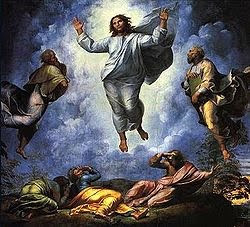
Friday: The Transfiguration of the Lord

The Transfiguration by Raphael

To celebrate the Transfiguration is not easy for most contemporary Americans, Catholic or not.  Mystical experiences are not one of our daily concerns or experiences.  We are a "here and now" people.  Mysticism is different.  It demands a movement from the business of the moment to something or someone outside ourselves, the exigencies of the moment or the environment where we might be.

Peter, James and John accompanied Jesus as he climbed Mt. Tabor.  Little did his companions expect to be witnesses  of a miracle.  Even more stupefying was the reality that the miracle was done to Jesus.  It is this event that is described by St. Thomas Aquinas as "the greatest miracle."

When the disciples awoke, presumably from their siestas, they were quietly overwhelmed by what they were privileged to see.  As Luke comments "becoming fully awake they saw his glory."  As well, they saw two men standing with him, Moses and Elijah. At one point a cloud descended upon "them."  Scholars are not certain whether it was an all-inclusive cloud or one that covered only Jesus, Moses and Elijah.

Once in the cloud "they" hear the voice of God:  "This is my chosen Son; listen to him."  After these words only Jesus was visible to them.  St. Luke comments that after this "they fell silent."  Obviously the disciples were stunned.  There were silent -- even the impetuous Peter.  It seems evident that they understood the need to remain silent -- lost in wonderment.

Can you possibly enter into the mystical moment we are celebrating today?  Take a few moments to understand it, to "get into it."  It is a gift.

Today is also the anniversary of the death of Pope Paul VI.